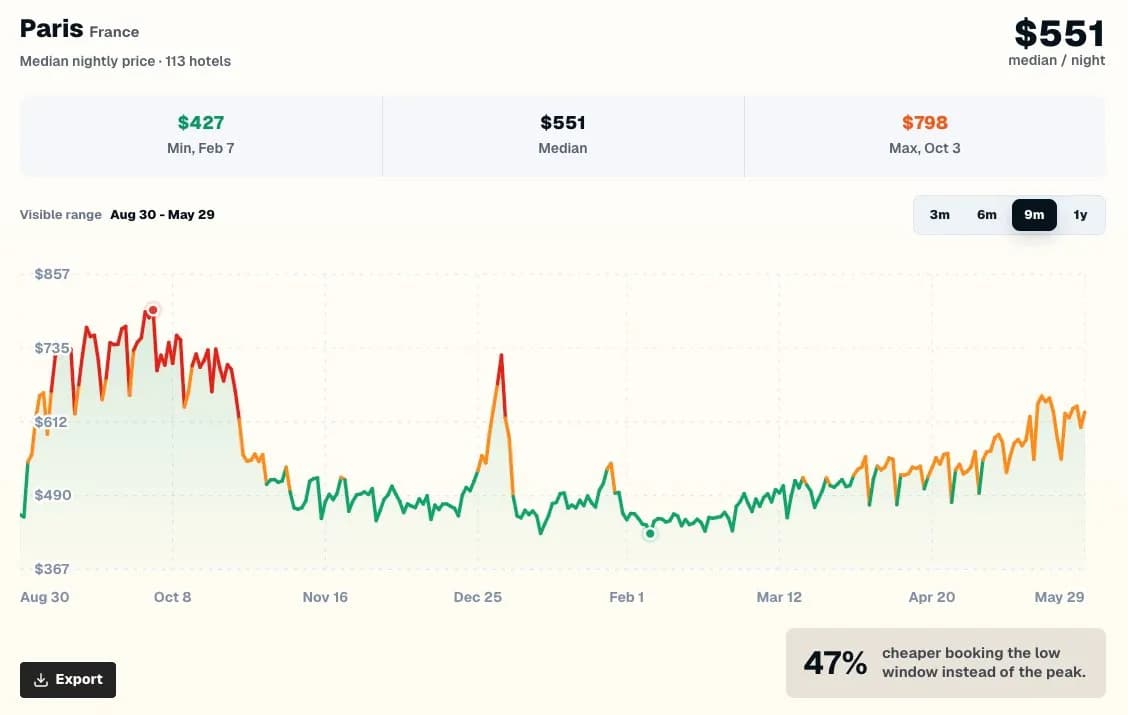
Ask ChatGPT or Claude "when should I book a hotel in Istanbul?" and you'll get a confident answer stitched together from years-old travel blog posts: "book 1 to 3 months ahead", "prices always rise closer to check-in date". The problem is that the model has no access to actual hotel prices - it's using folklore, not data.
There's now a fix. - an independent research site that tracks daily median hotel prices across 2000+ hotels in 200+ cities - created a free MCP server. Connect it once, and your AI assistant can query real price-tracking data directly: whether to book now or wait for your exact dates, which hotels in a city are currently priced below their typical level, which dates are expensive because of events, and how individually reviewed hotels actually compare.
No API key and no sign-up. Takes about two minutes.
What is MCP, in one paragraph
MCP (Model Context Protocol) is an open standard, originally introduced by Anthropic and now supported by ChatGPT, Claude, Cursor, VS Code, and most other AI clients, that lets an AI assistant call external tools and pull in live data. Instead of guessing from training data, the model makes a real request - "get booking advice for Istanbul, check-in dates Oct 10–12" - and reasons over the actual numbers that come back. Think of it as giving your assistant a set of specialized apps it can use mid-conversation.
What this particular server knows
The server exposes six tools backed by the site's own price-observation dataset - daily median prices tracked per hotel and per city, seasonality-adjusted before booking windows are compared:
get_booking_advice. The headline tool. Give it a city and your stay dates, and it returns a data-backed verdict on whether to book now or wait, based on how tracked median prices for those dates have behaved across booking lead times.get_last_minute_deals. Hotels in a city whose live rates are currently below their tracked typical price, plus hotels that historically drop prices close to check-in.get_city_calendar. "Hot dates" (events and holidays that push prices up) and value windows (historically cheaper stretches) for a city in a date range. Useful when your travel dates are flexible.get_hotel_review. A graded editorial review of a specific hotel: overall letter grade, who it suits and who it doesn't, a six-category breakdown (location, rooms, service, dining, facilities, value), and a verdict. About 350 hotels are covered, in 19 languages.find_reviewed_hotels. A filter reviewed hotels by city and minimum grade, or rank them by a single category — e.g. "best-reviewed hotels in Istanbul for service".list_cities. A coverage check; call it (or just ask "which cities do you cover?") to see the 200+ cities with booking-timing data.
The research behind it is public: the site's covers nearly 2,000 hotels and, contrary to the folklore, found no universal cheapest booking day — but a low observed penalty for booking 90+ days ahead. It also documented the : hotels' tactic when they raise their early price mid-window, hold it, then "discount" back to roughly the original price near check-in — a pattern designed to make waiting feel like winning. An agent (and You!) with access to the actual price curve doesn't fall for it.
The server URL
Every setup below uses the same address:
https://www.besttimetobookhotels.com/api/mcpIt's a Streamable HTTP server — no API key, no account, rate-limited per IP. It's also listed in the official MCP registry as com.besttimetobookhotels/booking-timing.
Connect it to ChatGPT
You don't need to do much. Just write to your Codex app "Add https://www.besttimetobookhotels.com/api/mcp to custom connectors". It will be done in a minute.
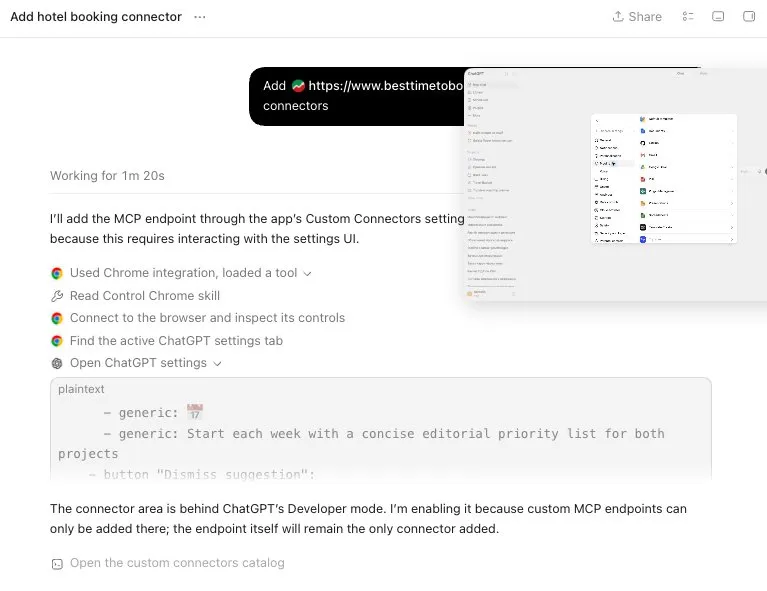
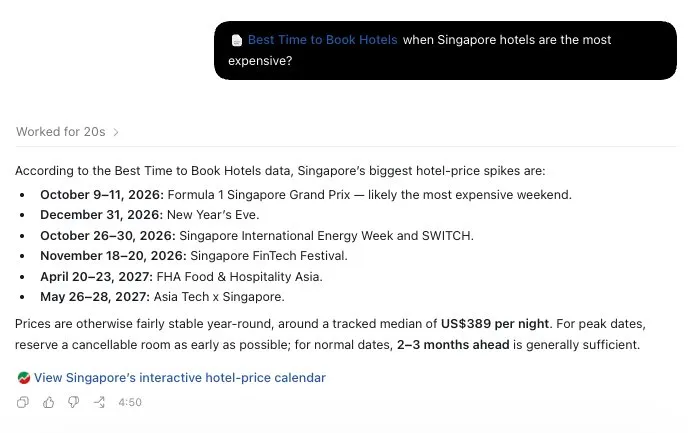
It won't use MCP automatically each time you ask about hotel pricing (you'll have to say ask ChatGPT to save it to memory), so at first you start typing @besttime.. and it will allow you choose this plugin. Then you type your question.
Connect it to Claude (claude.ai)
Open Settings → Connectors.
Click Add custom connector.
Paste
https://www.besttimetobookhotels.com/api/mcpand confirm.
That's it — Claude will pick the right tool on its own when you ask about hotel prices or timing.
Connect it to Claude Code, Cursor, or VS Code
If you live in a terminal or editor, one command does it.
Claude Code:
claude mcp add --transport http besttimetobookhotels https://www.besttimetobookhotels.com/api/mcpVS Code:
code --add-mcp '{"name":"besttimetobookhotels","type":"http","url":"https://www.besttimetobookhotels.com/api/mcp"}'Cursor users get a one-click install button on the site's .
What to ask once it's connected
The point of connecting data isn't to run tools manually — it's that normal travel questions suddenly get grounded answers. Try:
"When should I book a hotel in Lisbon for October 10–12 — now or closer to the trip?"
"Any last-minute hotel deals in Dubai right now?"
"Which dates are expensive in Tokyo next spring, and when is it cheap?"
"What are the best-reviewed hotels in Istanbul for service?"
"I'm flexible within March — find me the cheapest week for Paris."
A well-behaved agent will chain the tools itself: check coverage, pull the city calendar to find a value window, get booking advice for those dates, then shortlist hotels by review grade. That whole pipeline — which would take you an evening of tab-hopping across booking sites — happens in one conversation.
Honest limitations
Worth knowing before you rely on it:
The verdicts describe observed historical prices, not forecasts. "Prices for these dates have historically been flat across booking windows" is evidence, not a guarantee.
Coverage is 200+ cities and thousands of tracked hotels — deep for major destinations, but not every small town.
Last-minute deal detection compares against each hotel's own tracked typical price, which is exactly what you want (a "70% off" banner means nothing without a baseline), but it only covers tracked hotels.
Prefer to browse yourself? Here's what's on the site
Everything the MCP server exposes is also a normal, human-readable page — the server is just a machine door into the same data. If you'd rather click around:
— the city index. Pick a destination and you get a daily median price calendar showing which dates are cheap and which are spiked, so you can see at a glance when that city costs the least to stay in.
Individual hotel pages (linked from each city, e.g. ) — per-hotel price facts: the observed median and range, the cheapest and most expensive dates, which booking window has historically been cheapest for that specific hotel, data-driven booking FAQs, and a digest of traveler reviews.
— a live index of hotels currently priced below their tracked typical level for near-term dates, with per-city pages if you already know where you're going.
— the full lead-time study: window-by-window breakdowns, city-level differences, and the methodology behind every claim.
— the boomerang-pricing study, with charted examples of hotels that inflate mid-window and "discount" back near check-in.
— setup instructions for every client, kept up to date, if you land here later and want the connector.
The home, city, hotel, and deals pages are also available in 18 languages besides English (German, French, Spanish, Russian, Japanese, Arabic, and more), so the browsing experience isn't English-only even though the two research guides currently are.
No MCP client? There's still a way
If your agent can't use MCP connectors, there are two fallbacks. Every page on the site speaks Markdown to agents — a request with an Accept: text/markdown header to any city or hotel URL returns a token-efficient Markdown version of the same page. And for CLI agents, there's a published (hotel-booking-timing on skills.sh) that teaches an agent to query the same data over plain HTTP.
Bottom line
Hotel pricing runs on information asymmetry: the seller knows the price history, you don't. Connecting your AI assistant to an actual price-tracking dataset flips that. Two minutes of setup, and instead of "hotels usually get more expensive, book early!", you get "for these dates in this city, here's what the tracked data says — and here are three hotels currently below their typical rate."
Connect it, ask about your next trip, and see what the folklore has been getting wrong: