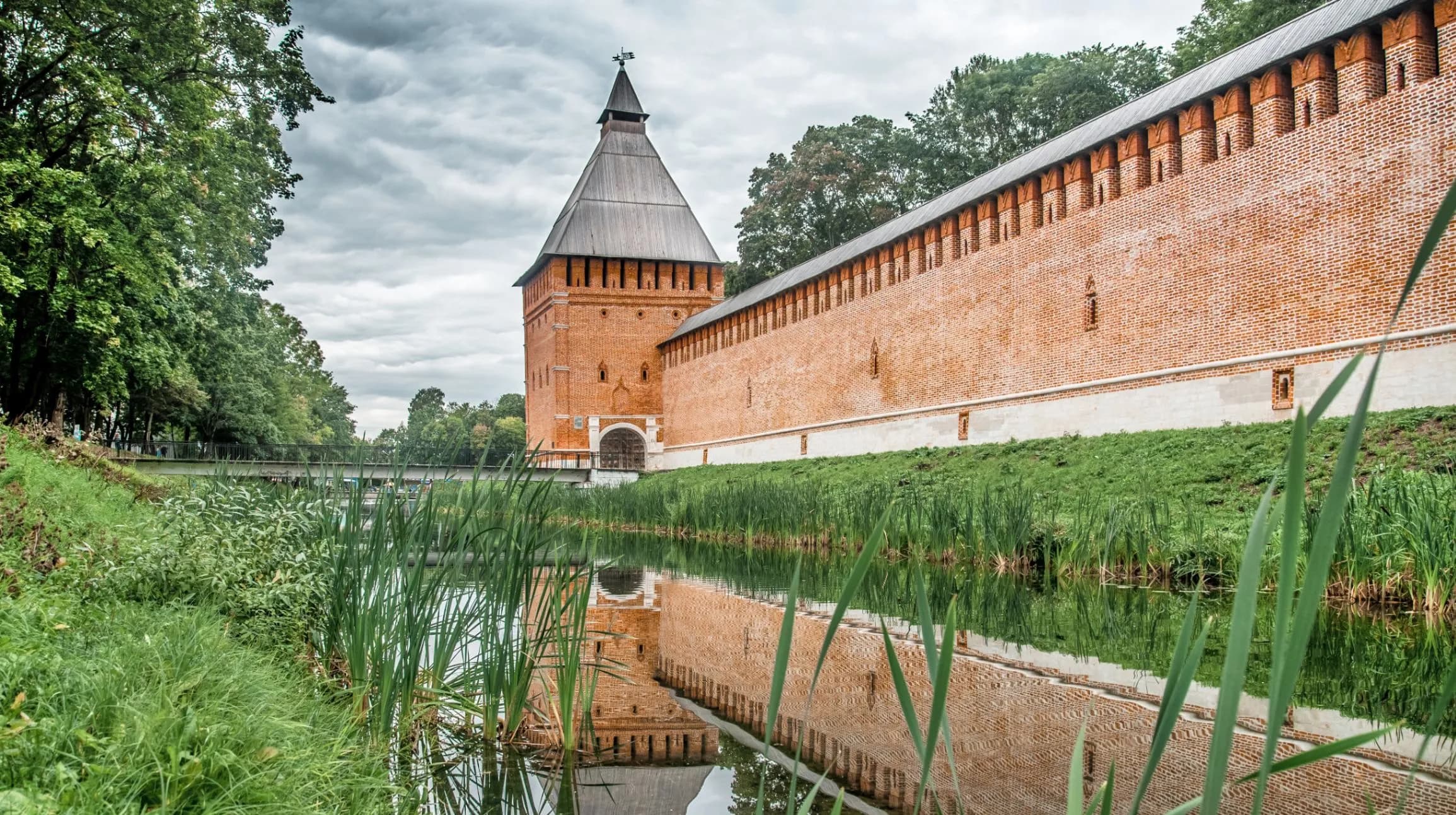

A perfect destination for a weekend trip from Moscow (and from many other places too). The Lastochka train from the capital takes just four hours — those in a real hurry can even make it a day trip.
Smolensk sits on seven hills, so even a short walk through the city center can easily turn into a light cardio workout. Comfortable walking shoes are genuinely important here. The easiest way to navigate the center is by following the fortress wall and its towers. They keep appearing in your field of view and help you get a good sense of where you are in relation to the historic center. And yet all these ancient churches, the fortress wall, and the historic architecture remain largely overlooked by tourists.
Smolensk Oblast lies in western Russia, between Moscow and Belarus. Smolensk is 365 kilometers from Moscow and 330 from Minsk. The M-1 Belarus highway runs through the region. This makes the city a convenient destination both as a standalone weekend getaway and as part of a longer route heading toward the Belarusian border.
The Smolensk Fortress — "The Necklace of All Russia"
The Smolensk fortress wall is a complete defensive ring that once almost entirely encircled the city. It was built between 1595 and 1602 under Tsar Fyodor Ioanovich, under the direction of the architect Fyodor Kon. The total length of the wall reached approximately six and a half kilometers, making it one of the longest stone fortresses in Russia by that measure. In most Russian cities, fortifications either did not form a complete circle or did not reach such a scale.
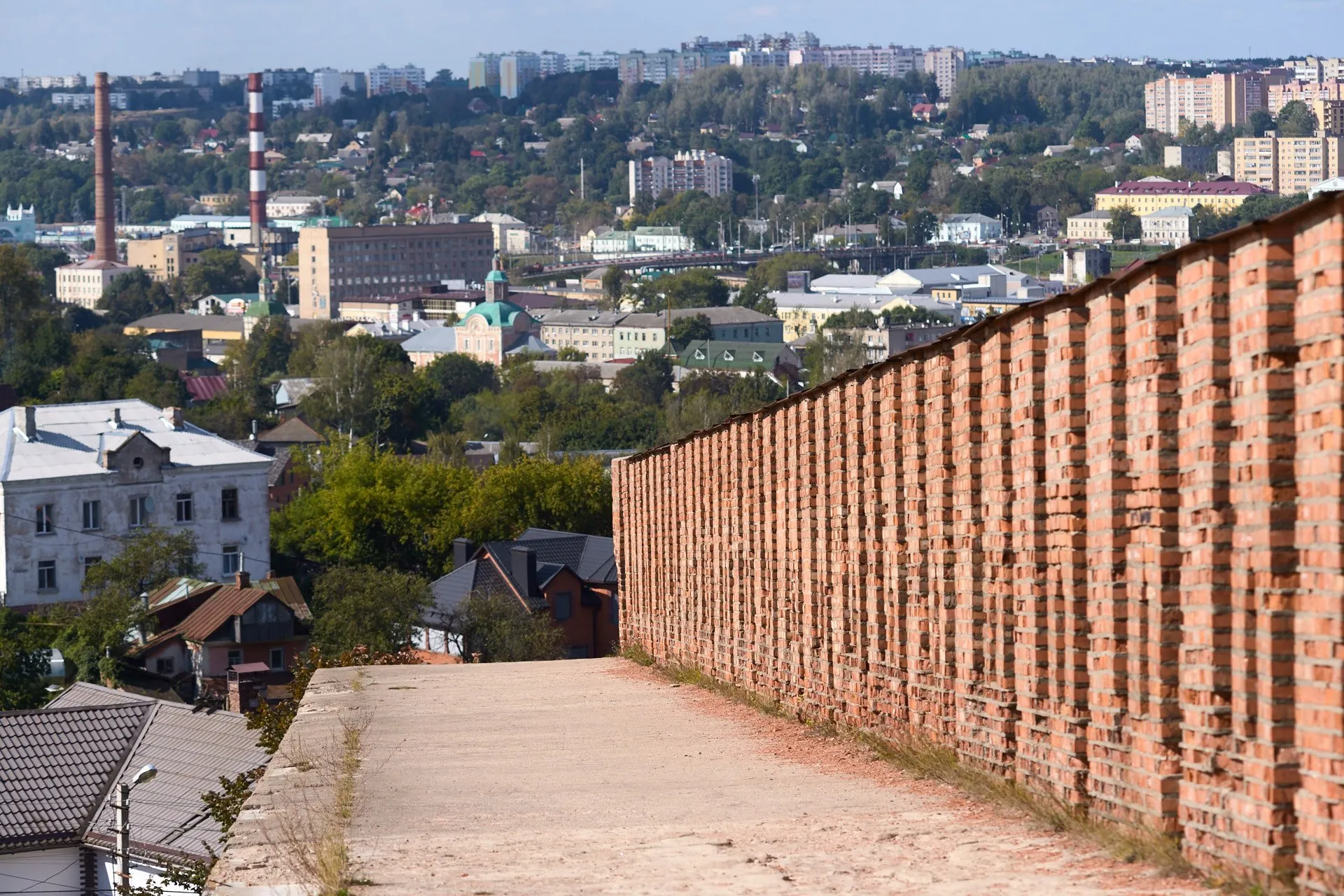
The wall was designed from the outset as a defensive system: up to six meters thick, 13 to 19 meters high, with more than 30 towers and a carefully planned defensive line that took the terrain into account. It does not simply "stand" around the city — it defines its shape. Even today, by tracing its surviving fragments you can read where the boundary of old Smolensk ran when it was still a fortress.
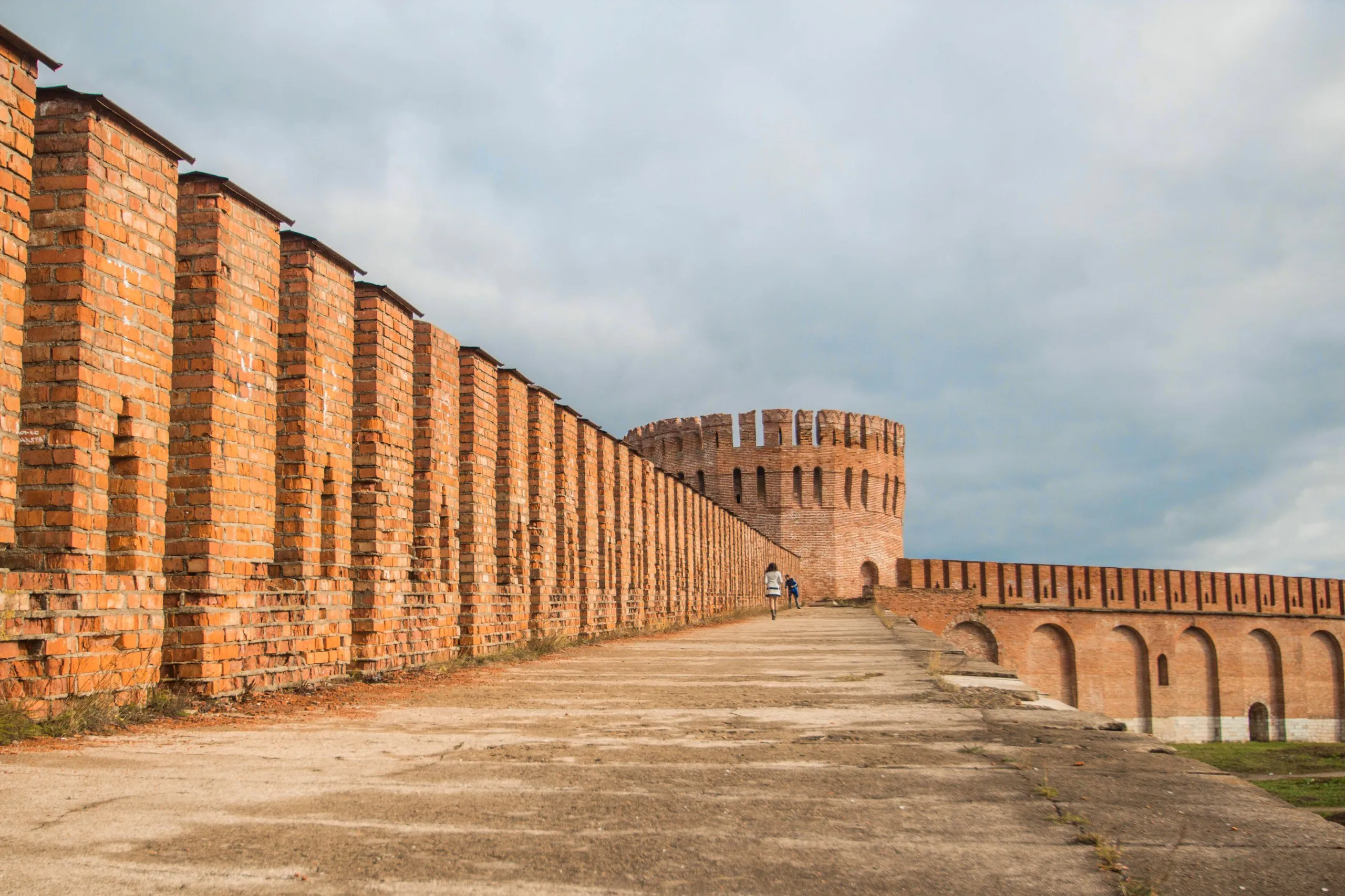
Today, three and a half kilometers of the fortress wall survive, and these fragments are woven into the fabric of the modern city. Gas stations stand beside sections of the brickwork, a ski slope runs nearby, an open-air cinema operates close by, a television tower rises in the area, and the gates of Spartak stadium practically abut the wall.
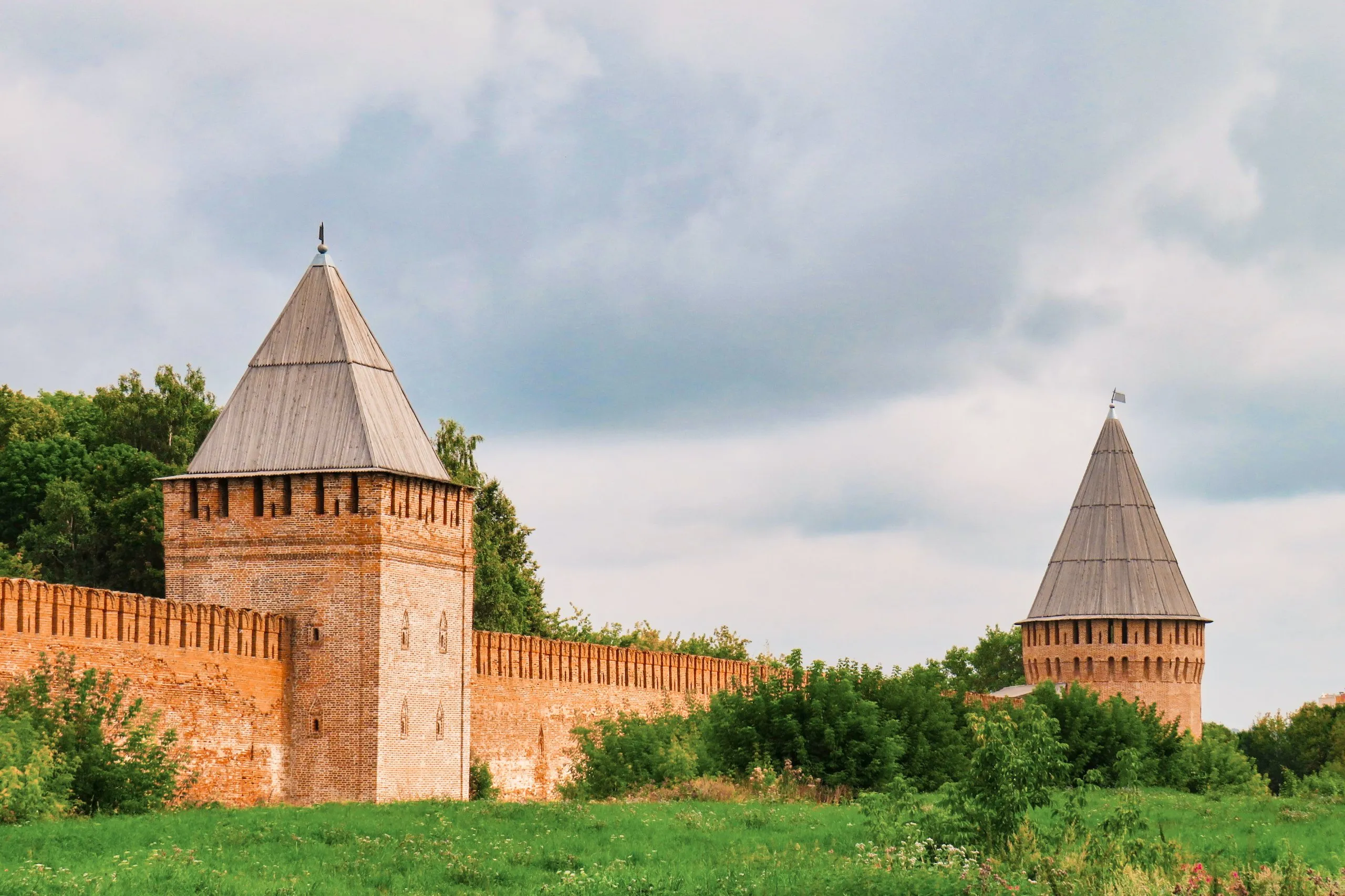
No two towers of the Smolensk fortress are alike. They come in round, polygonal, and rectangular forms, and their configuration depended on the terrain and the section of wall they occupied. Some towers reinforced vulnerable approaches, others controlled roads, and others served as gatehouse towers — equipped with gates. Originally there were nine gates connecting the fortress to roads leading toward Moscow, Kyiv, and the western lands. Today, roads still pass through some of these gatehouse towers. Cars drive beneath vaults that are more than 400 years old, following the same routes once used by wagon trains and travelers entering the city. The towers were positioned so that the space between them could be clearly observed and defended. Originally there were 38 towers; only 18 survive to the present day.
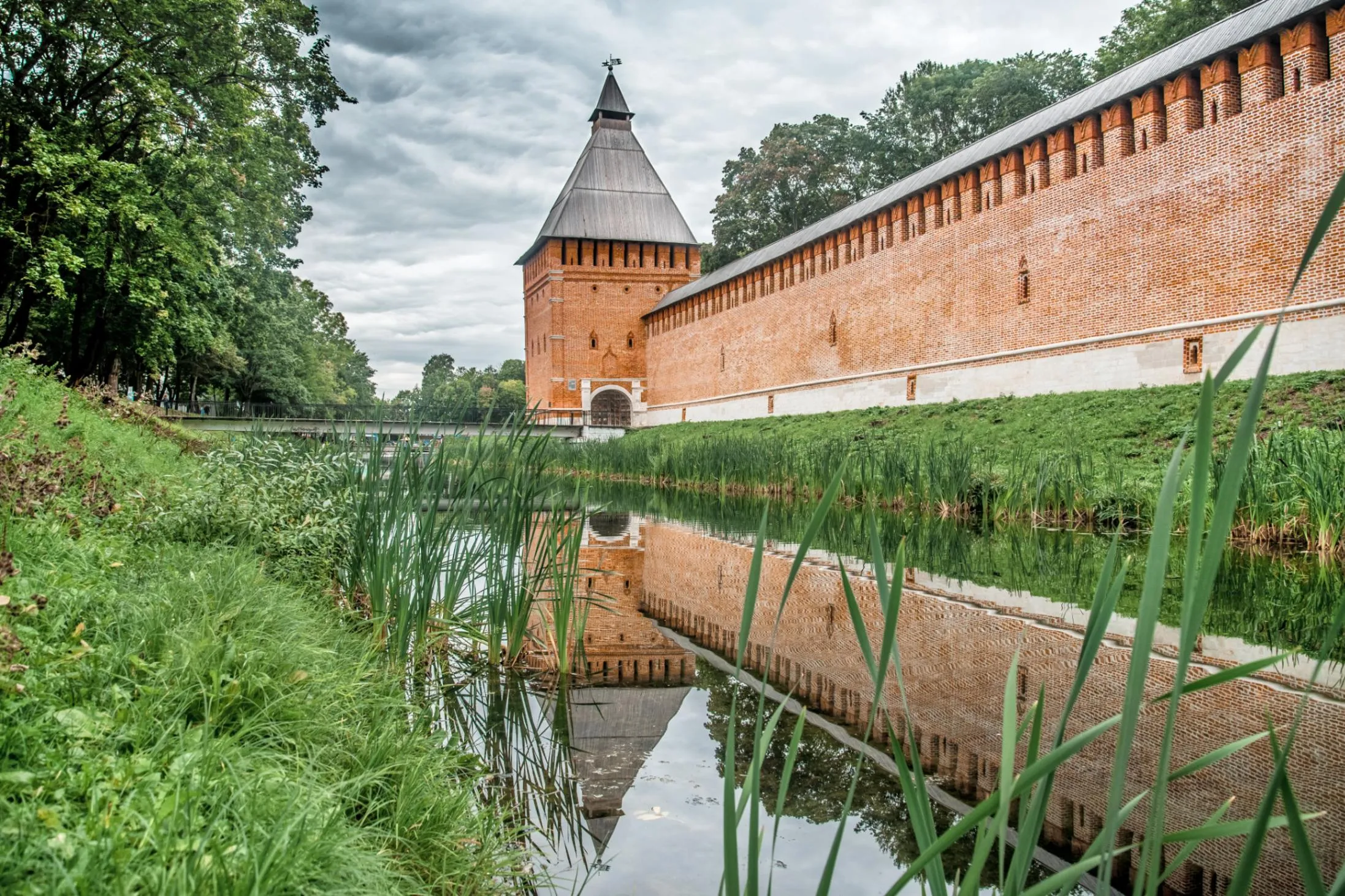
The Nikolskaya Tower is one example of a gatehouse tower. Its original gate passage was arranged "with a bend" — that is, with a turn to the left — making any assault considerably more difficult. The gates were closed by a drop-down iron portcullis called a gersa. Later, at the end of the 19th century, the through passage was blocked, and a new wide arch was cut through the adjacent section of wall nearby; a tram ran through it starting in 1901. Since 2014, the tower has housed a museum. "Smolensk Linen".
The Kopytenskaya Tower is one of the largest on the southern wall. Even before it was built, a path had existed on this spot along which Smolensk residents drove their livestock to pasture, and this cattle track remained in use long after the defensive structure was erected. Its passageway was arranged in an L-shape to complicate any assault, and icons in icon cases stood above the arches on both sides. A fortress moat once ran in front of it; today, a pond in Lopatinsky Garden occupies that space. During the siege of Smolensk in 1609–1611, one of the main blows of the Polish forces fell precisely on the Kopytenskaya Tower. Later, under Catherine II, its gates were bricked up and the tower itself was adapted for use as an archive of Smolensk Governorate.
The Orlovskaya Tower stands on a section of the wall where the ground drops sharply and controlled approaches from the direction of the lowland. Its polygonal form widened the field of view and fire.
The Veselukha Tower features massive walls, narrow embrasures, and several tiers. It stands on one of the highest points along the fortress line, which gave it an excellent view over the Dnieper valley — it served as a proper observation post. Its polygonal form, typical of a number of Smolensk towers, widened the arc of fire. Inside the tower, traces of floors and embrasures at different levels survive, indicating that the defense was conducted in tiers rather than from a single line.
The Makhovaya Tower. Inside are several levels, embrasures at different heights, and passages running through the thickness of the walls. From the outside it appears as a small square tower; its name, first recorded in the 19th century, may be connected to garrison commander Ivan Makhovtsov during the siege of 1609. In 1857 the tower was converted into an archive, and today it houses the exhibition "The Streltsy World".
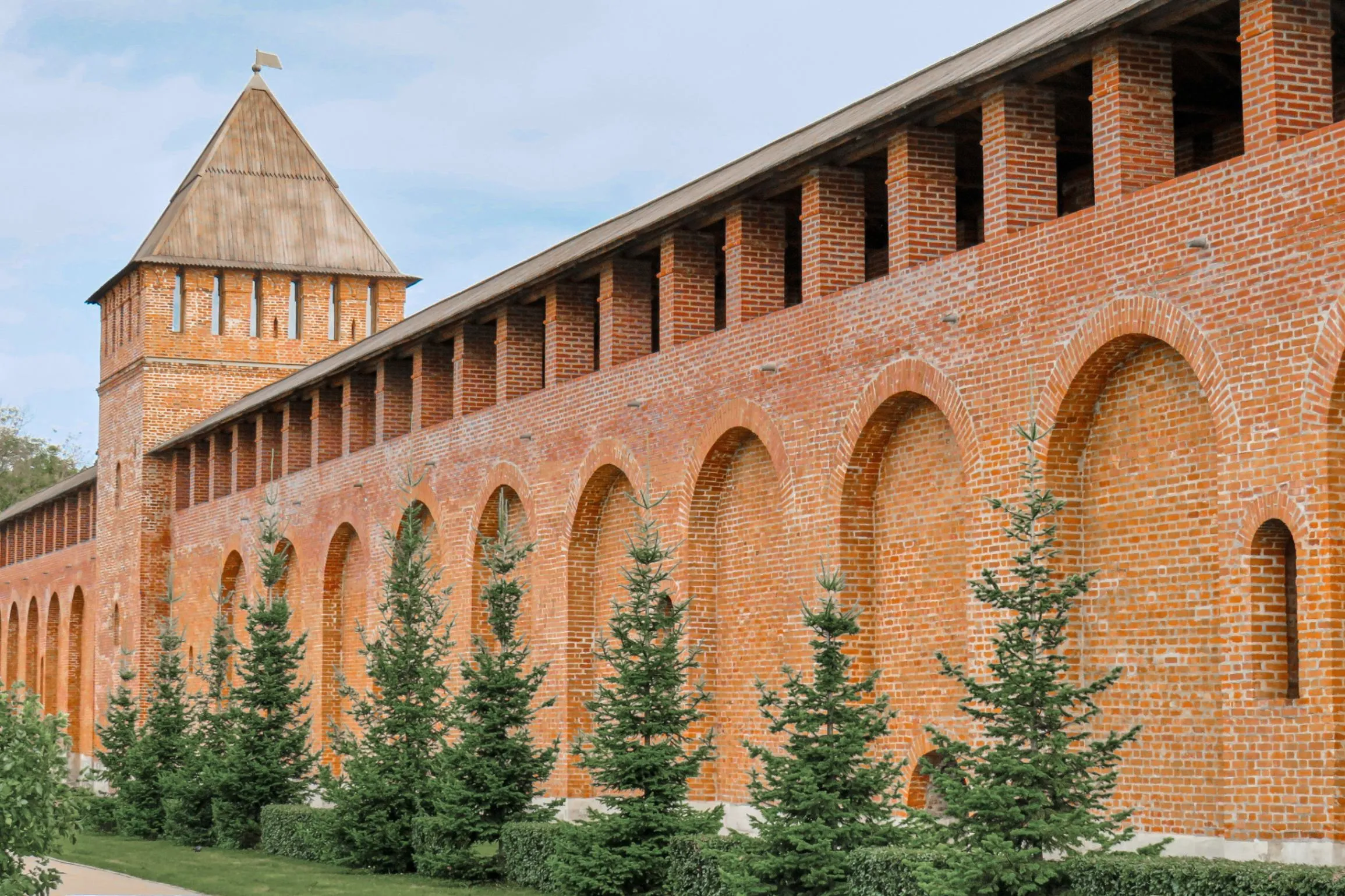
The Gromovaya Tower is located in the central section of the wall and today functions as a museum. The exhibition lets you see how the fortress was organized from the inside: several levels, rooms for the garrison, passageways, embrasures — and just how thick the walls are. In places they reach four meters, with corridors and staircases built into their depth.
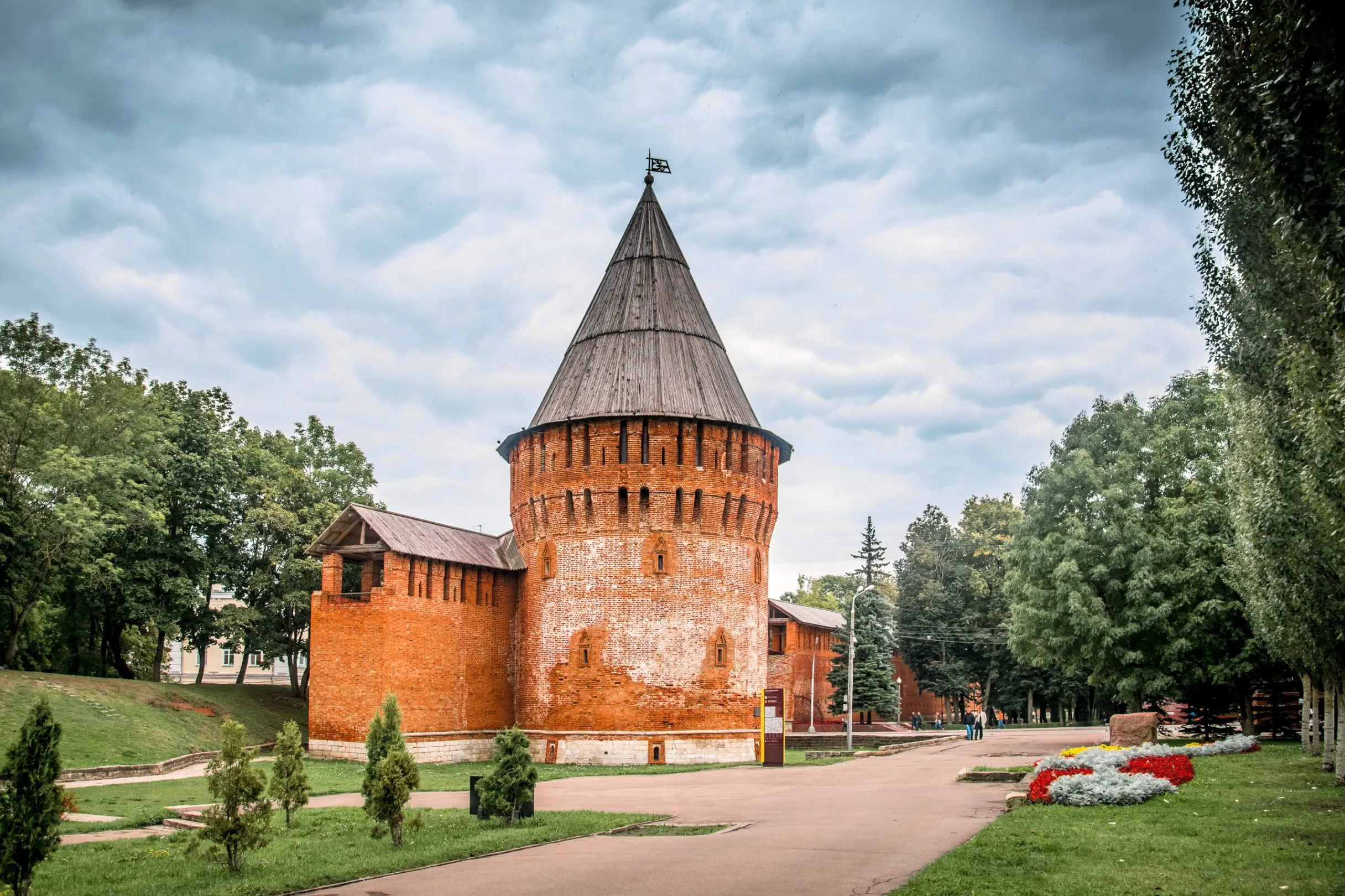
Churches on the Hills and the Pre-Mongol Era
Assumption Cathedral (Svyato-Uspensky Cathedral) (17th–18th centuries)
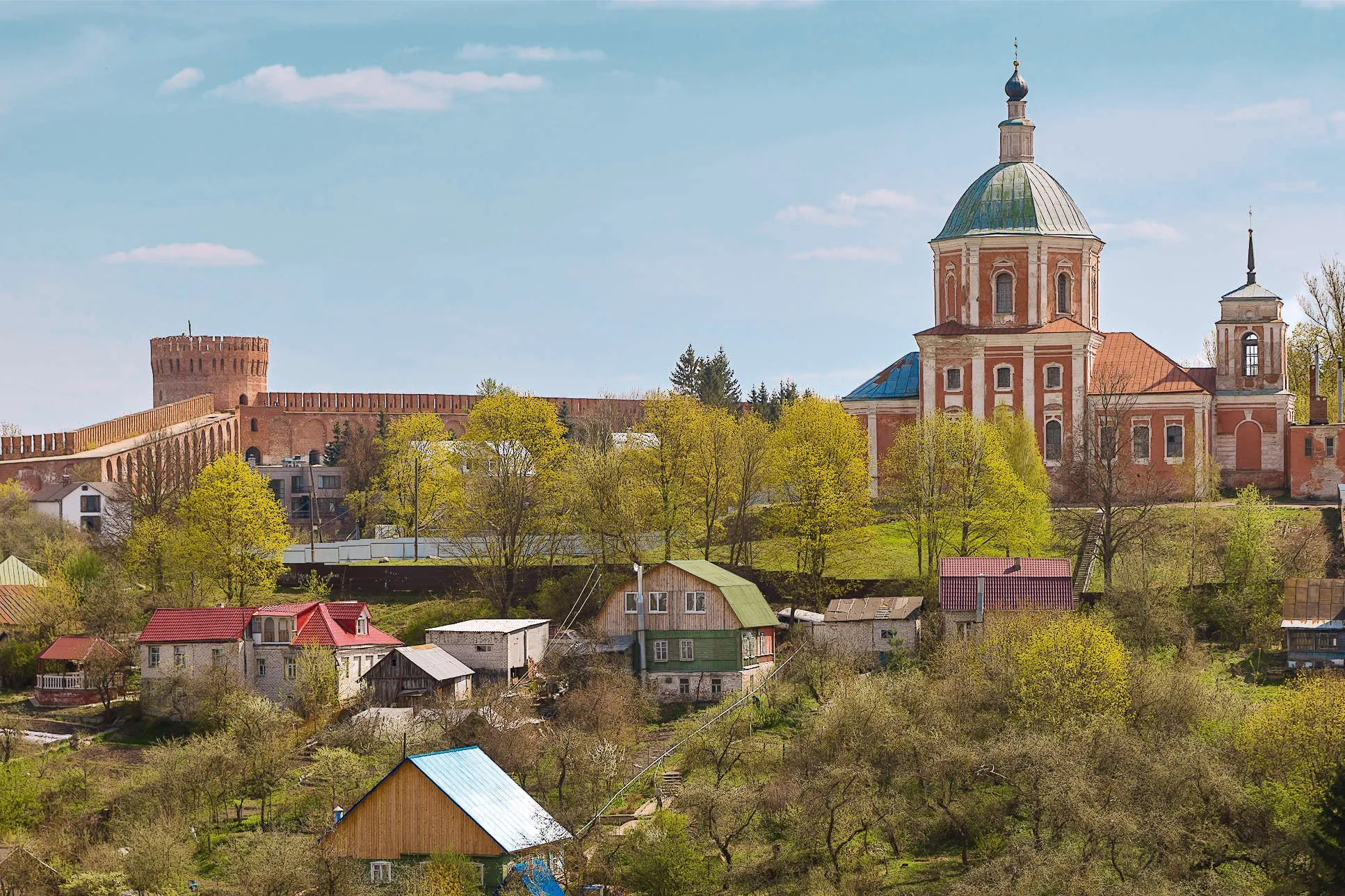
The road to Assumption Cathedral is already half the experience. It stands on Cathedral Hill, 60 metres above the Dnieper, and is visible from almost everywhere. You descend toward the river — it looms above you; you cross the bridge — it reappears on the horizon. The whole city seems arranged so that you never lose sight of the church.
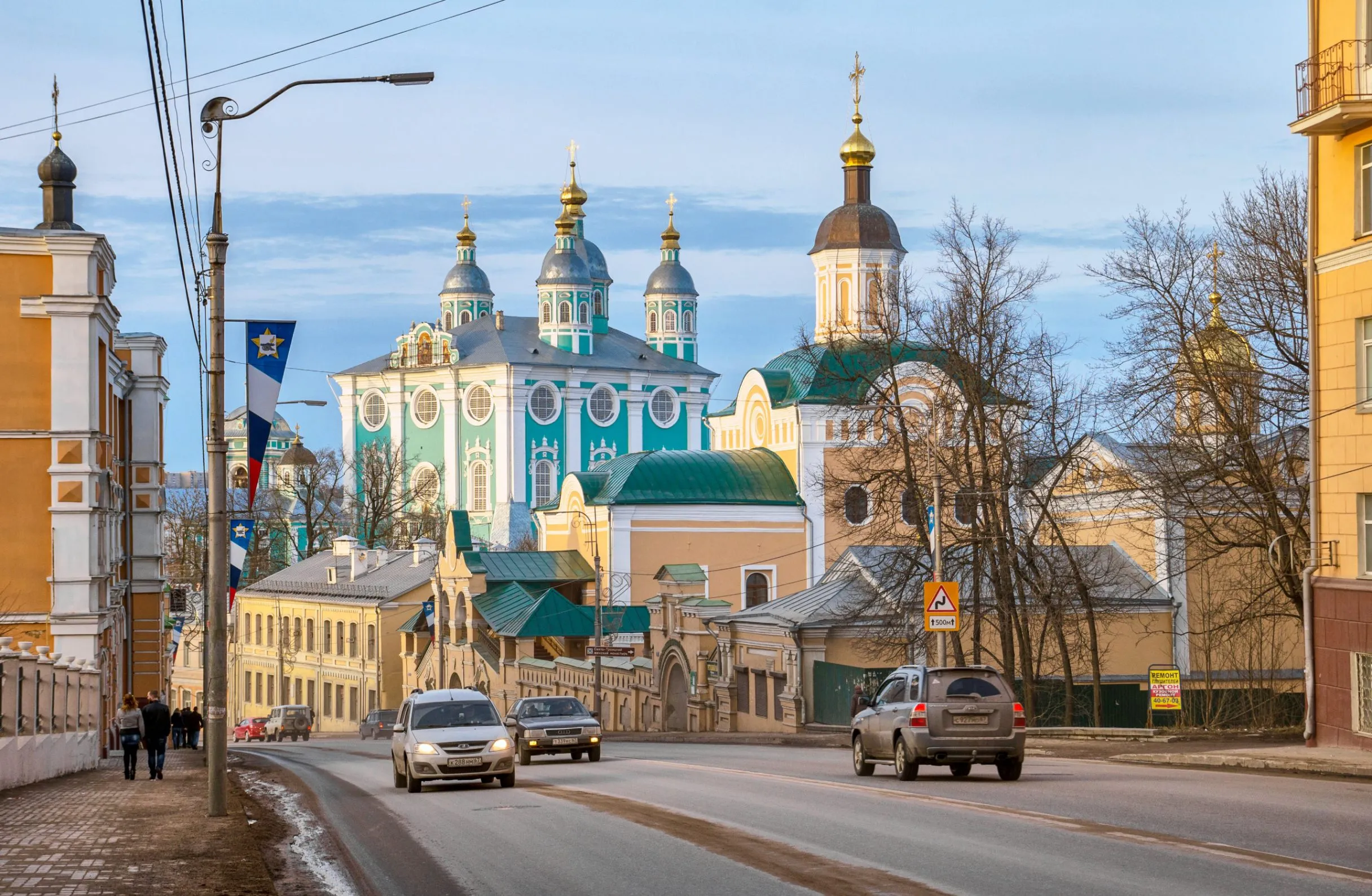
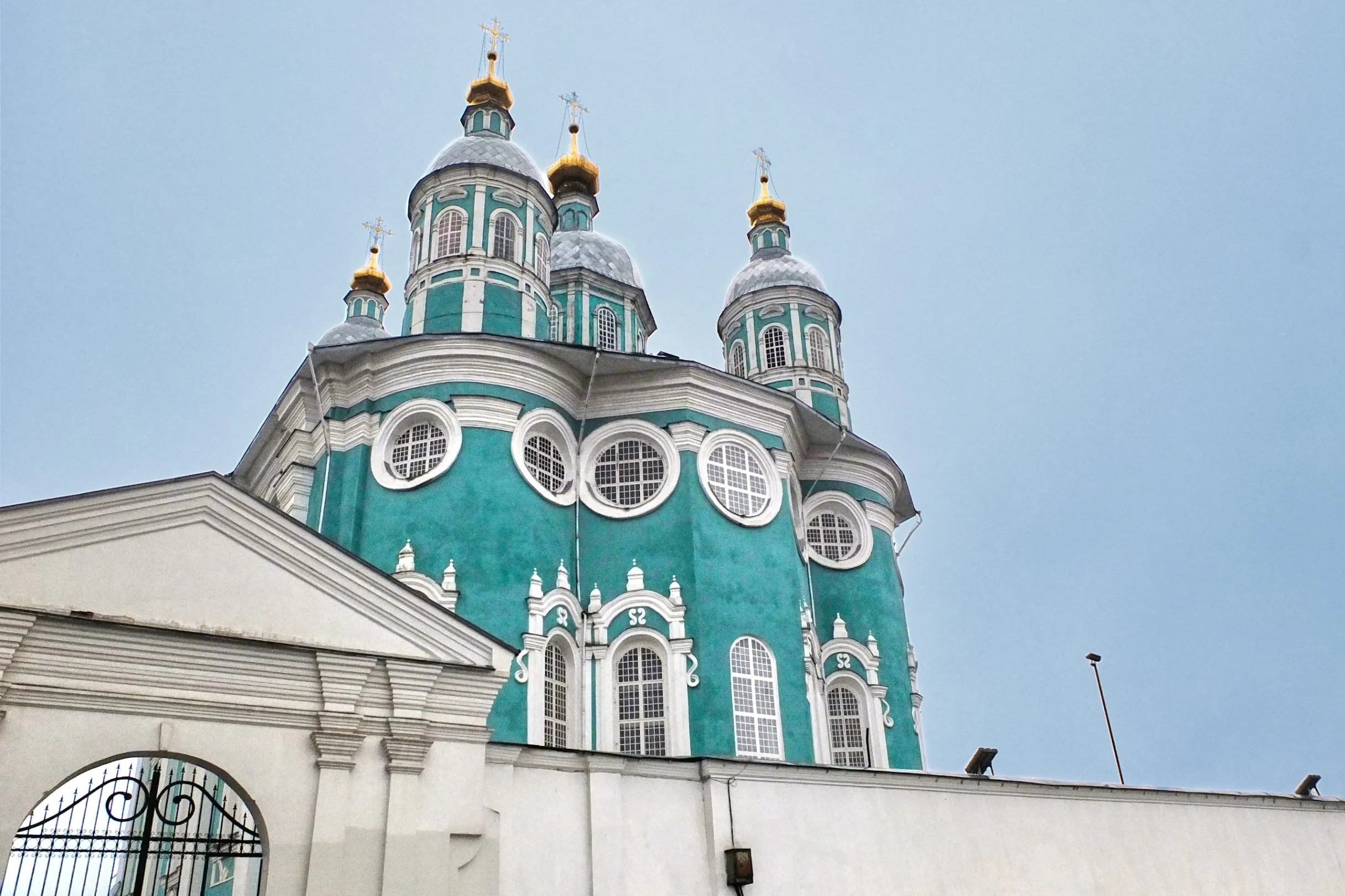
The cathedral was built in the 17th and 18th centuries on the site of a church destroyed during the siege of 1611. When Smolensk fell in 1611, many residents took shelter in the ancient Monomakh Cathedral that stood on this spot. At the height of the assault, the powder stores exploded, the vaults collapsed, and the church was badly damaged.
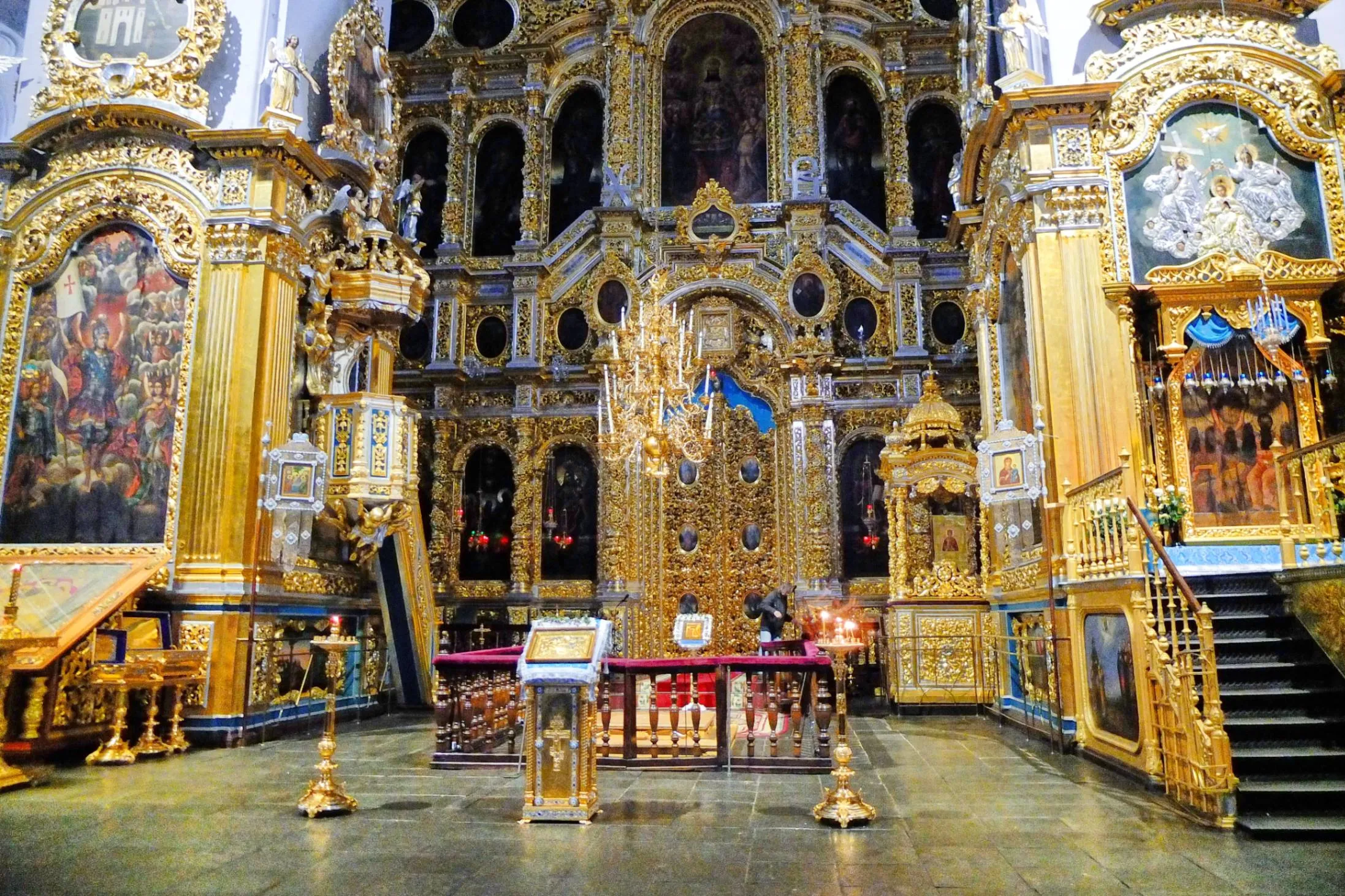
Outside, there is a turquoise façade, grey domes, and a tall Baroque silhouette. Inside, a five-tiered iconostasis stands roughly 30 metres high — carved and covered in gilding. It almost entirely fills the eastern wall and reads as a separate architectural structure in its own right. The cathedral also holds important historical relics, from the ancient Smolensk Icon of the Mother of God 'Hodegetria' to an 18th-century burial shroud captured from a French supply column after the War of 1812 and kept in the city as a token of gratitude for Smolensk's defence. Even if religious architecture is not usually your thing, it is worth stepping inside for the sheer scale and light: the space feels almost theatrical, yet never pompous.
Avraamiev Monastery (16th–18th centuries)
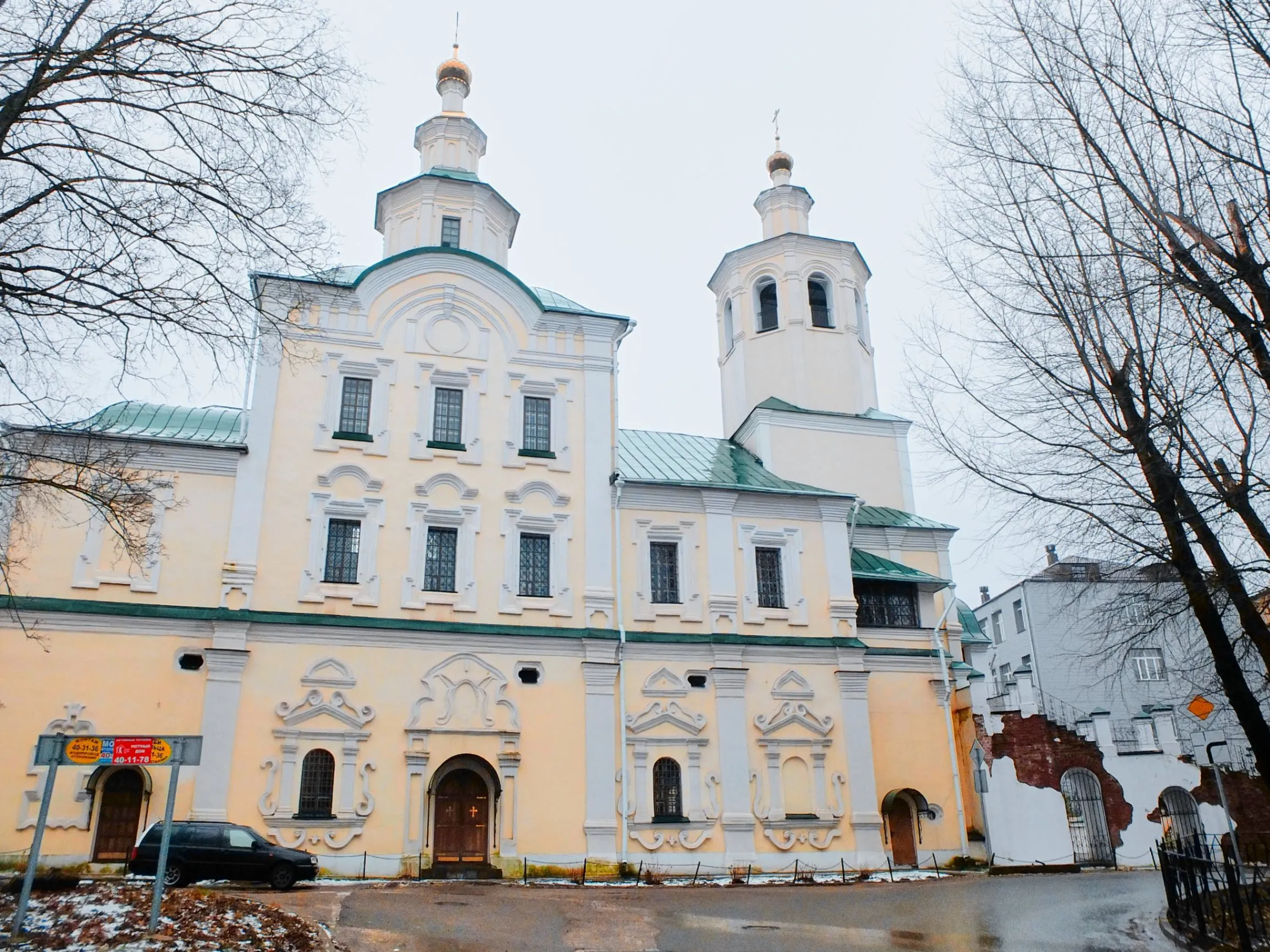
Avraamiev Monastery sits amid ordinary city blocks. The centrepiece of the complex is the Cathedral of the Transfiguration. Its present appearance took shape between the 16th and 18th centuries: a cross-domed church with pale yellow walls, white decorative detail, and a tall cylindrical drum beneath a green dome. Inside, the space is far more intimate than in Assumption Cathedral — less ceremonial grandeur, more of a monastic quiet. Beside it rises the monastery's tall bell tower with an octagonal belfry tier.
When the fortress wall was built around Smolensk in the 16th century, the monastery found itself inside the perimeter but retained its own enclosure with towers. The result was almost a 'fortress within a fortress' — an arrangement unusual for urban monasteries.
Church of the Immaculate Conception of the Virgin Mary (1896)
Red brick, pointed arched windows, strong verticals — and you immediately sense that you are not in a typically Orthodox landscape. The Church of the Immaculate Conception of the Virgin Mary was built between 1894 and 1896 for Smolensk's Catholic community.
By the late 19th century, the city's Catholic community had grown to around nine thousand people, and the previous church could no longer accommodate all its parishioners. The new neo-Gothic church was designed to hold roughly three thousand worshippers, which was a very large capacity for the time. The interiors were decorated by craftsmen from Warsaw, who painted the vaults, created the stained-glass windows, and designed the altar compositions.
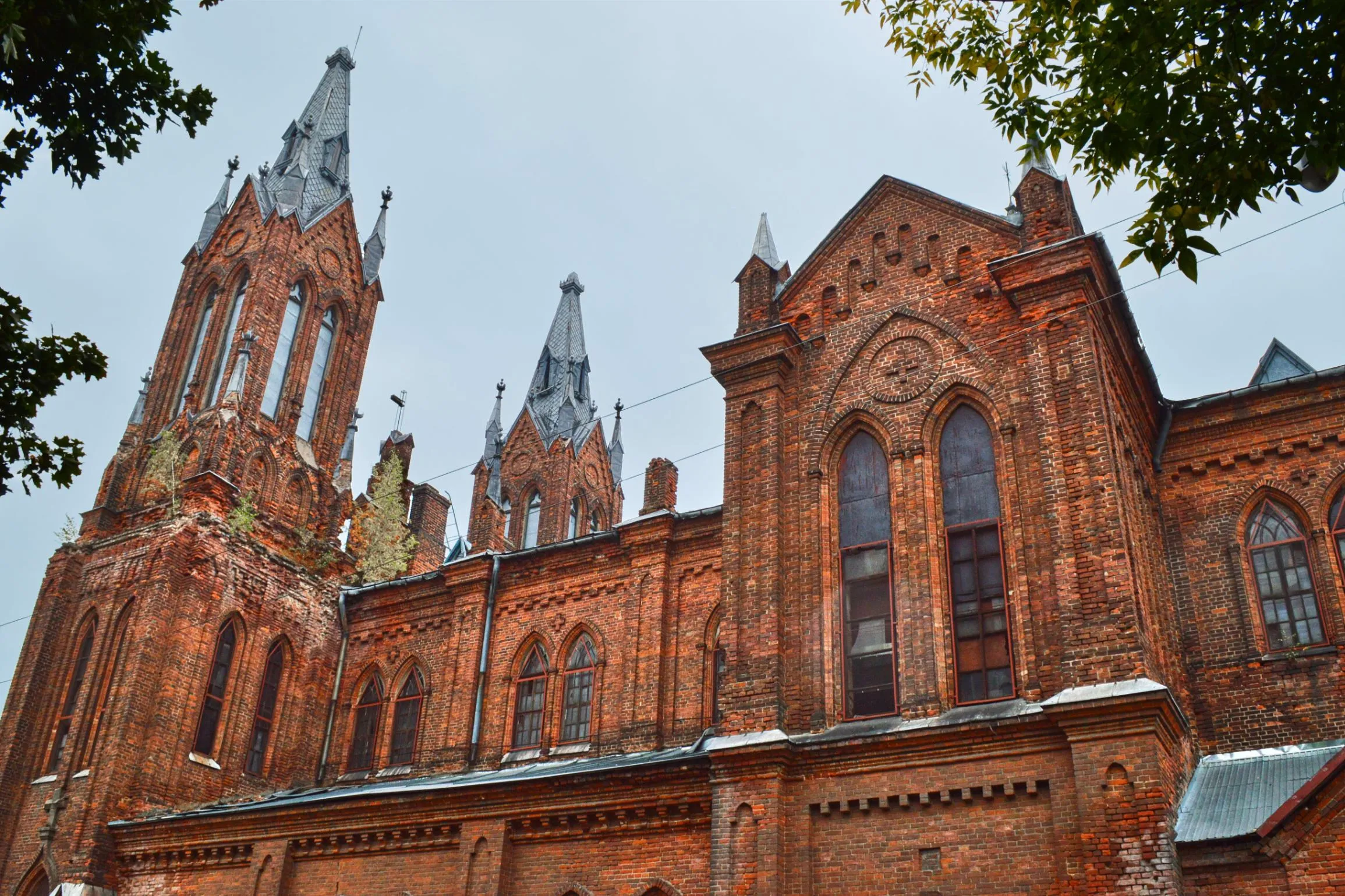
Originally the building was even more striking. The façade was crowned by two tall Gothic towers with spires visible from far away. In the 1930s services ceased and the rector was arrested. The building was later handed over for use as an archive — first to the NKVD, then to the State Archive of Smolensk Oblast. Multi-tiered shelving was installed inside for the archive holdings, and the spires, bells, and some decorative elements were dismantled. The archive remained here until 2012. After it moved out, the building stood empty and gradually fell into a dangerous state of disrepair. Emergency stabilisation work is now under way, and the authorities have spoken of plans for a full restoration of the church by 2028.
An old Catholic cemetery adjoins the church. By the early 20th century, Smolensk's Catholic community numbered around 20,000 people out of a total city population of roughly 100,000. The gravestones bear Latin epitaphs, stone crucifixes, and small family tomb-chapels. Some slabs still retain oval porcelain medallions with photographs, and cast-iron crosses with decorative openwork ornament can be found, while certain monuments display family coats of arms or monograms.
Buried here are Stefan Denisevich, the rector of the church during whose tenure the present building was constructed; Moisei Izabolinsky, a professor of microbiology; and the Gedroits family, an ancient Lithuanian princely line. There are also entirely unexpected stories — for instance, the grave of Italian opera singer Giovanni Aliboni, who died while on tour in Smolensk in 1899. Today the cemetery looks rather neglected: some enclosures are overgrown with grass, and many monuments have fallen or been damaged.
Pre-Mongol Churches
Only 29 churches from the pre-Mongol period have survived in Russia. Three of them are in Smolensk.
Church of Saints Peter and Paul (1146)
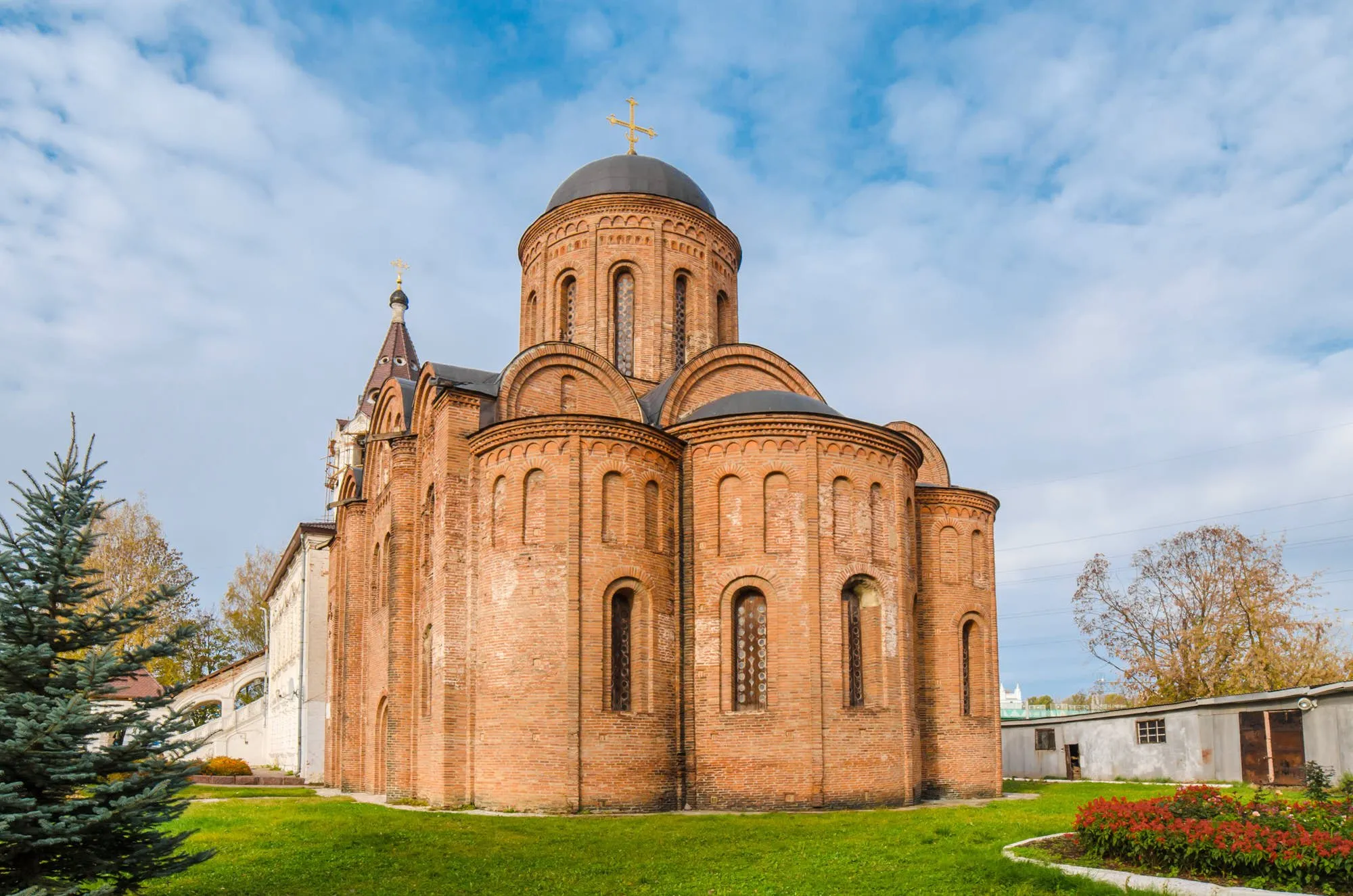
The Church of Saints Peter and Paul on Gorodyanka was built under Prince Rostislav Mstislavich and consecrated by the first Bishop of Smolensk. The church is constructed from plinth — the thin Byzantine brick typical of the 12th century. There is none of the decorative exuberance of the Baroque here: thick walls, narrow windows, and austere proportions give the building an almost ascetic quality. Over eight centuries the church survived conversion into a Catholic chapel during the period of Polish rule, plundering in 1812, and severe damage during the Second World War.
Church of John the Theologian on Varyazhki (1173)
The Church of John the Theologian on Varyazhki was built in 1173. The name 'Varyazhki' is linked to an old trading quarter: the routes along which merchants and craftsmen came into the city ran nearby. This was not a princely centre like the Svirskaya Church (discussed below), but part of the medieval town, and so the church originally served as a parish church for the residents of the posad.
The architecture here is just as austere as that of the other early Smolensk churches. The building is constructed from plinth in a cross-domed plan, with plain facades and narrow windows and almost no decorative elements. Over the centuries the church was rebuilt and restored several times following wars, so its appearance today differs from the original.

Svirskaya Church (1194)
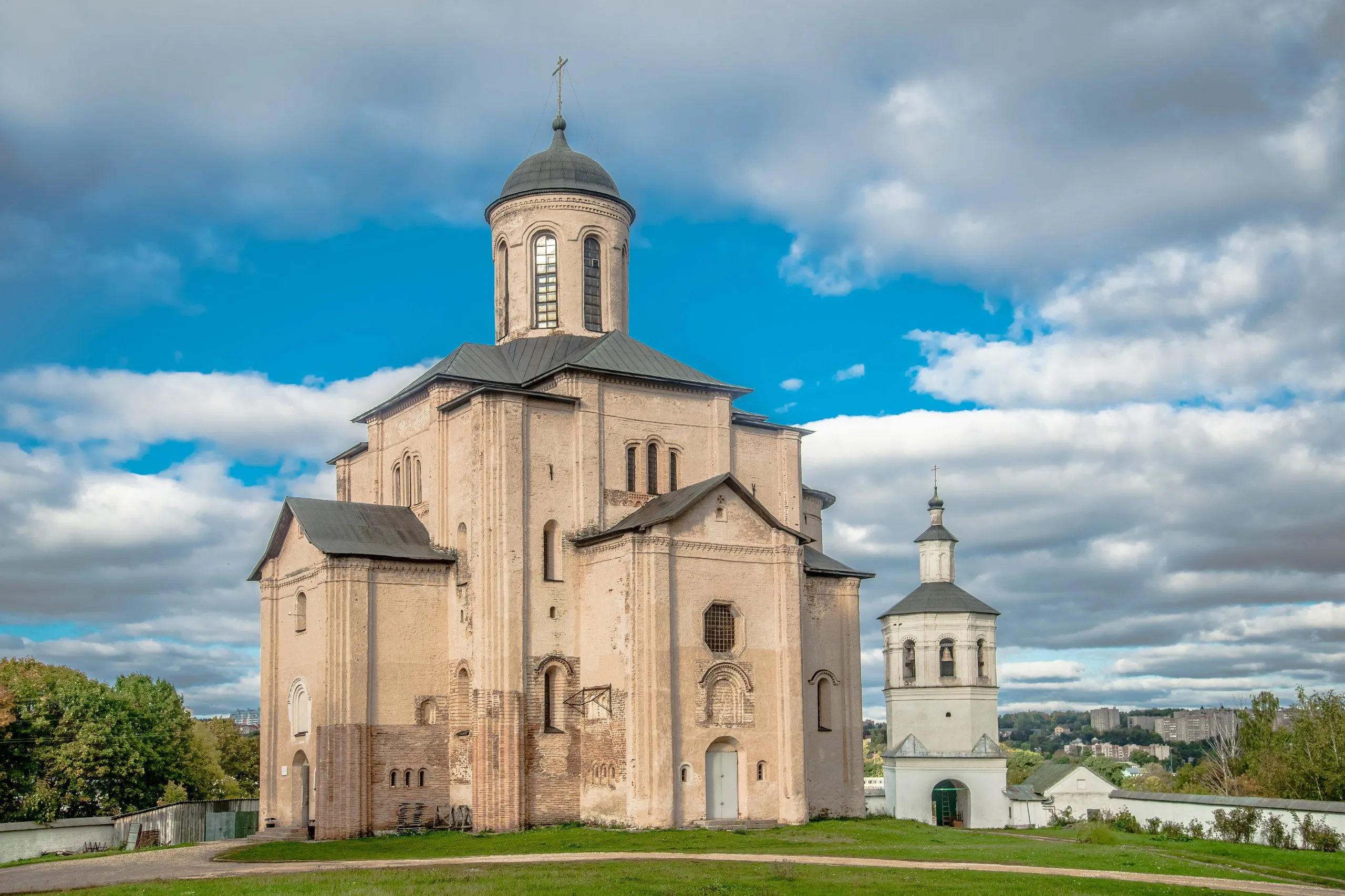
The Svirskaya Church (Church of the Archangel Michael) was commissioned by Prince David Rostislavich. Its architecture is unusual for its time. It is a cross-domed, four-pier structure, but its composition is arranged so that the building resembles a tall tower: the central volume rises steeply upward, and the pillars inside create a sense of vertical movement through the space.
The church stands on a hill above the Dnieper, on the site where the princely court once stood. From here you can clearly see how old Smolensk was built — its changes in elevation and the line of the river.
The main pre-revolutionary streets
Bolshaya Sovetskaya is one of Smolensk's main historic streets. Walking up from the Dnieper toward Cathedral Hill, you climb continuously, with buildings rising like steps toward the silhouette of the Assumption Cathedral.
As far back as the Middle Ages, a road ran here from the Dnieper wharf and trading quarter up to the upper town and fortress. In pre-revolutionary times, Bolshaya Blagoveshchenskaya became the most important street in the city. The main shops, hotels, and apartment buildings were concentrated here. Despite the name change in the Soviet era, the street itself barely changed its function. Just as a hundred years ago, it still has shops, cafés, and a lively urban atmosphere.
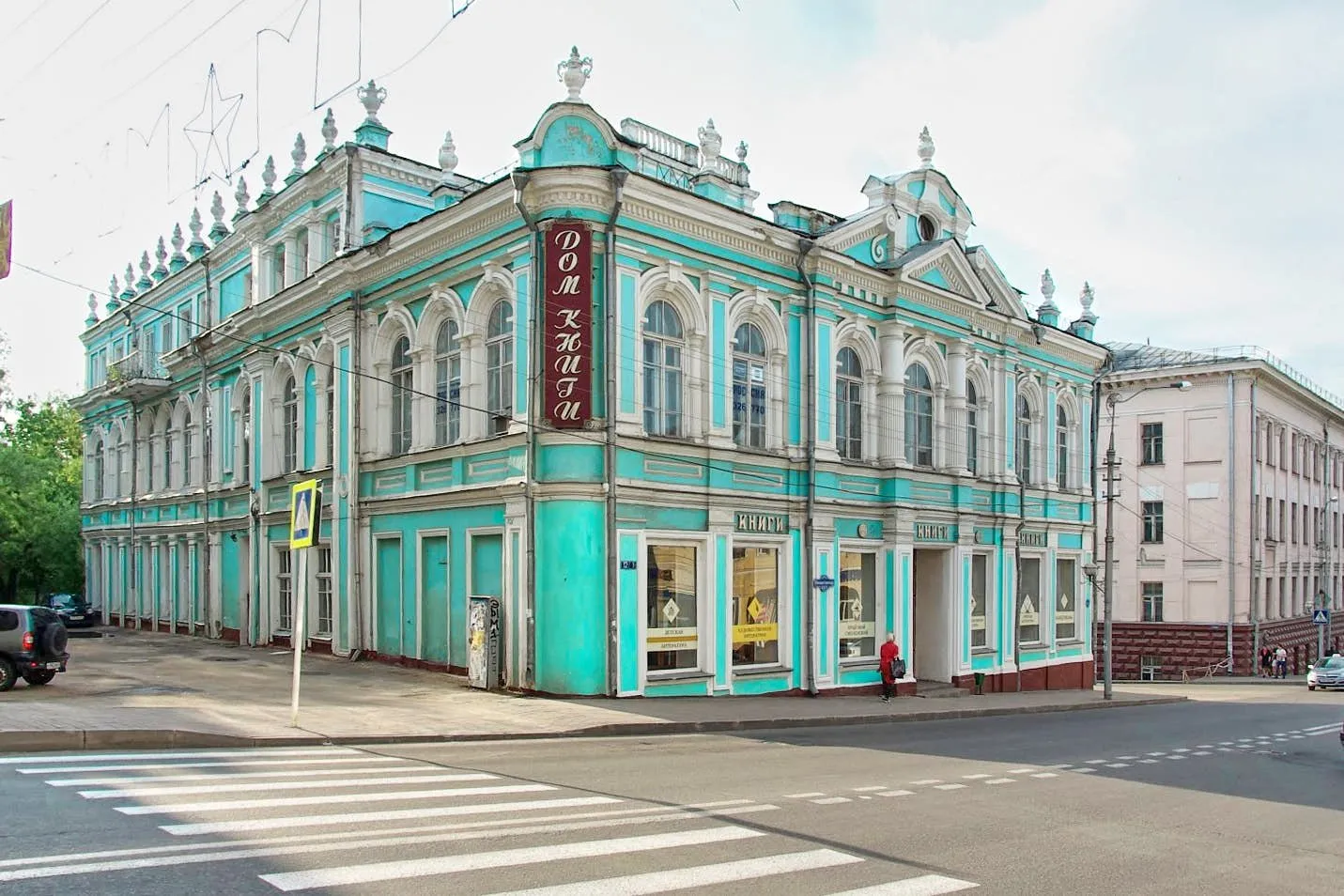
Dom Knigi (House of Books) is one of the most prominent buildings on the street. It was built in 1889 to a design by architect Mikhail Meishner for First Guild merchant Grigory Pavlov, owner of one of the largest fashion stores in pre-revolutionary Smolensk. It was a typical late-19th-century income-generating building: the ground floor housed a shop selling clothing, fabrics, and furs, while the upper floors contained residential apartments and rentable premises. In 1903 a third floor was added, giving the building its present-day silhouette.
After the revolution the building was nationalized. In 1919 the House of Education Workers opened here, with a library, reading room, and assembly hall, while the upper floors were converted into a dormitory for teachers. Literary evenings were held here — over the years poets Alexander Tvardovsky and Mikhail Isakovsky both performed in the hall. Before the war the building was renamed the House of the Teacher, which housed a Gosizdat bookshop and a periodical subscription point.
During the 1941 bombings the building was almost completely destroyed. In 1955 it was restored, preserving the historic facade with its decorative pediments, cornices, and vases on the parapet. A bookshop opened here once again — the very Dom Knigi that continues to operate to this day.
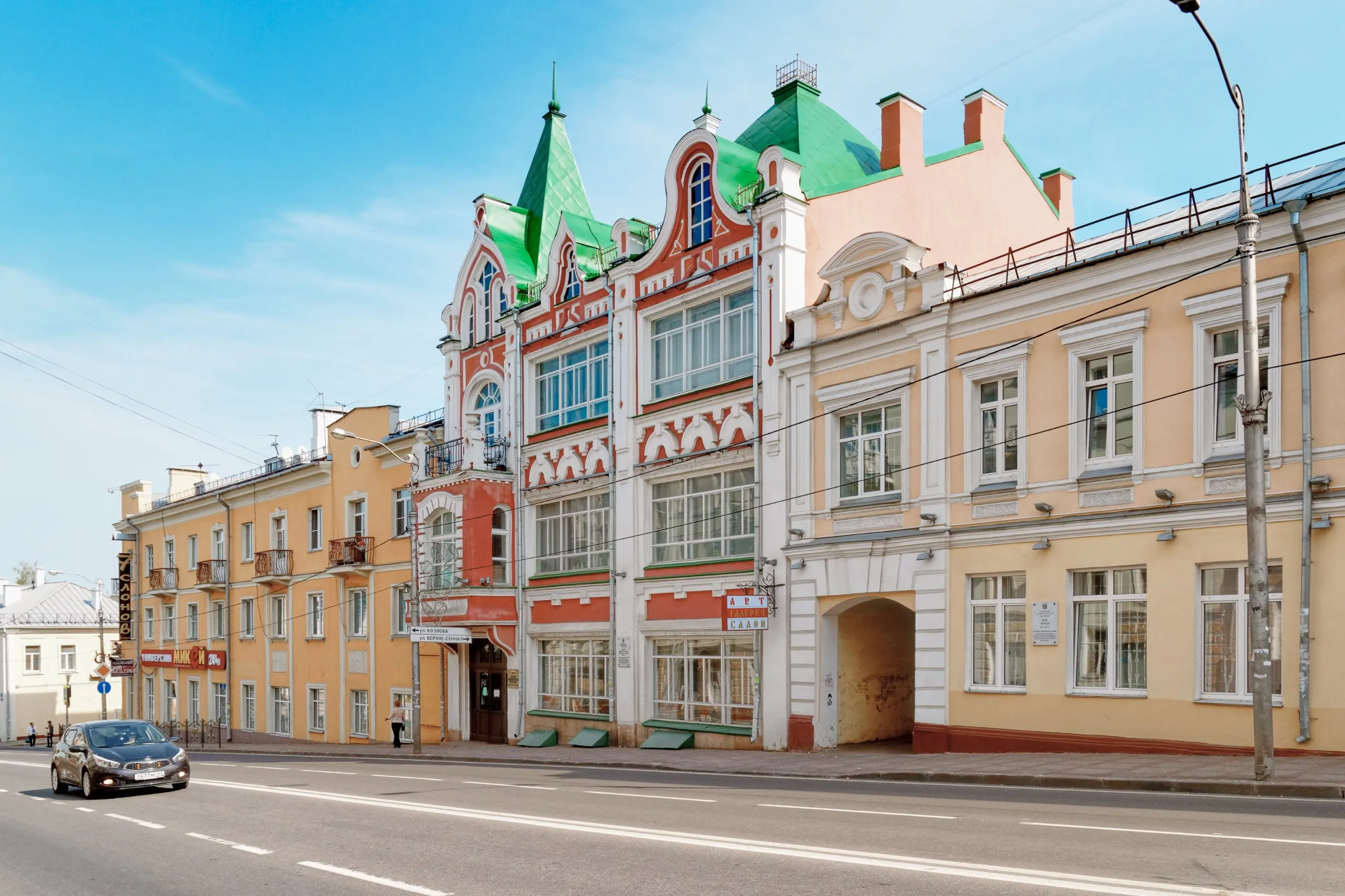
Dom Khudozhnika (House of the Artist). Its facade stands out with an asymmetrical Art Nouveau silhouette and a bay window with a balcony. There was once a vegetable shop on the ground floor. A giant turnip was even painted in the shop window — because of it, the artists whose studios were later housed under the building's roof jokingly called it "Na Repe" ("At the Turnip"). Over time the building became part of the city's artistic life: the Smolensk branch of the Union of Artists of Russia moved in, and exhibition halls and an art salon appeared.
In the 1970s, artists' studios were fitted out under the roof, gradually turning the building into a hub for creative gatherings and exhibitions. Today it serves the same cultural function: instead of shops and apartments, it hosts exhibitions and working artists' studios.
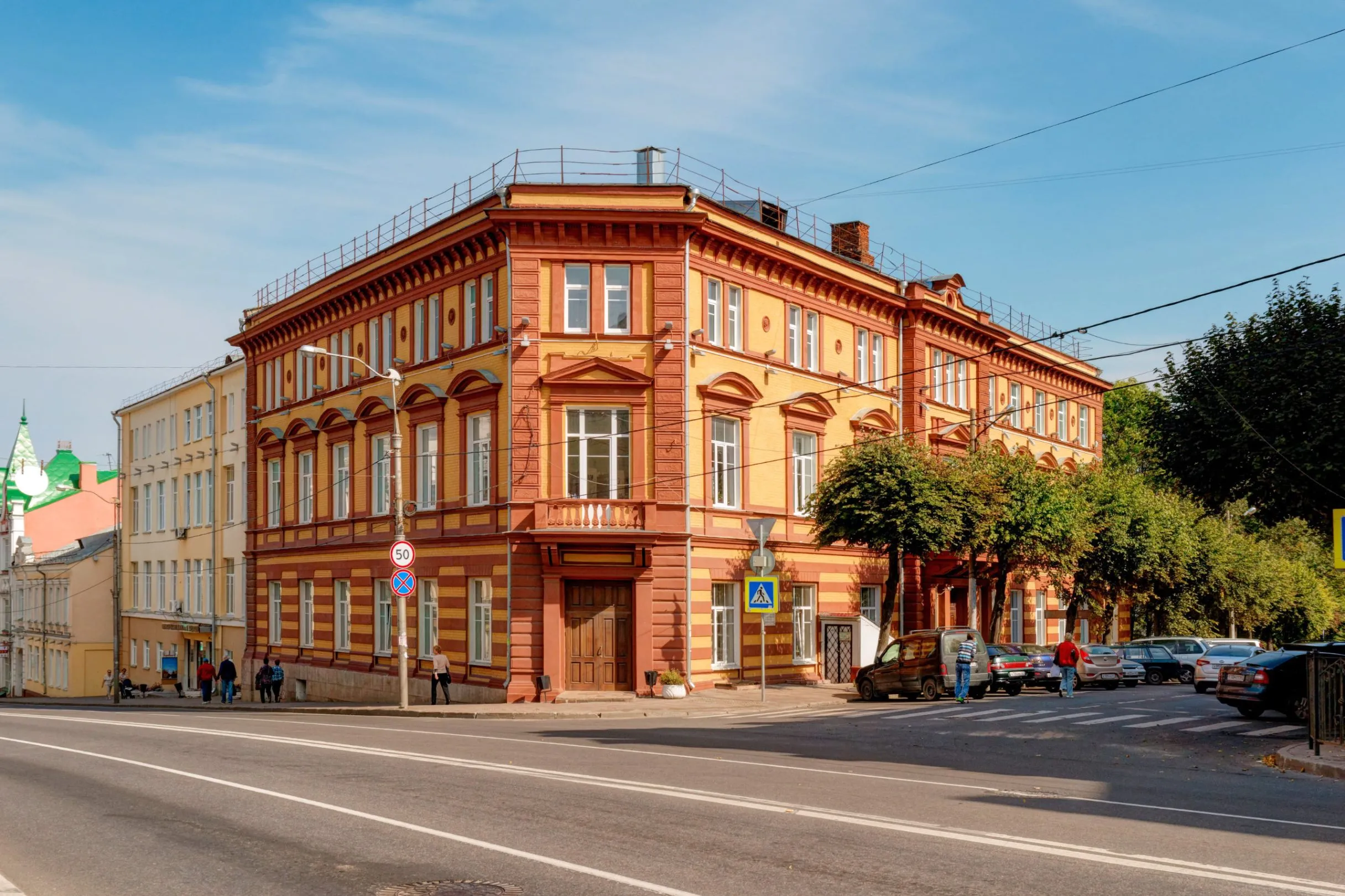
The former Merchants' Assembly building where business meetings and gatherings were held in the 19th century, is now home to the Smolensk Regional Universal Scientific Library. The spaces designed for assemblies and public life turned out to be well suited to reading rooms, so the change of function took place without any radical reconstruction of the building.
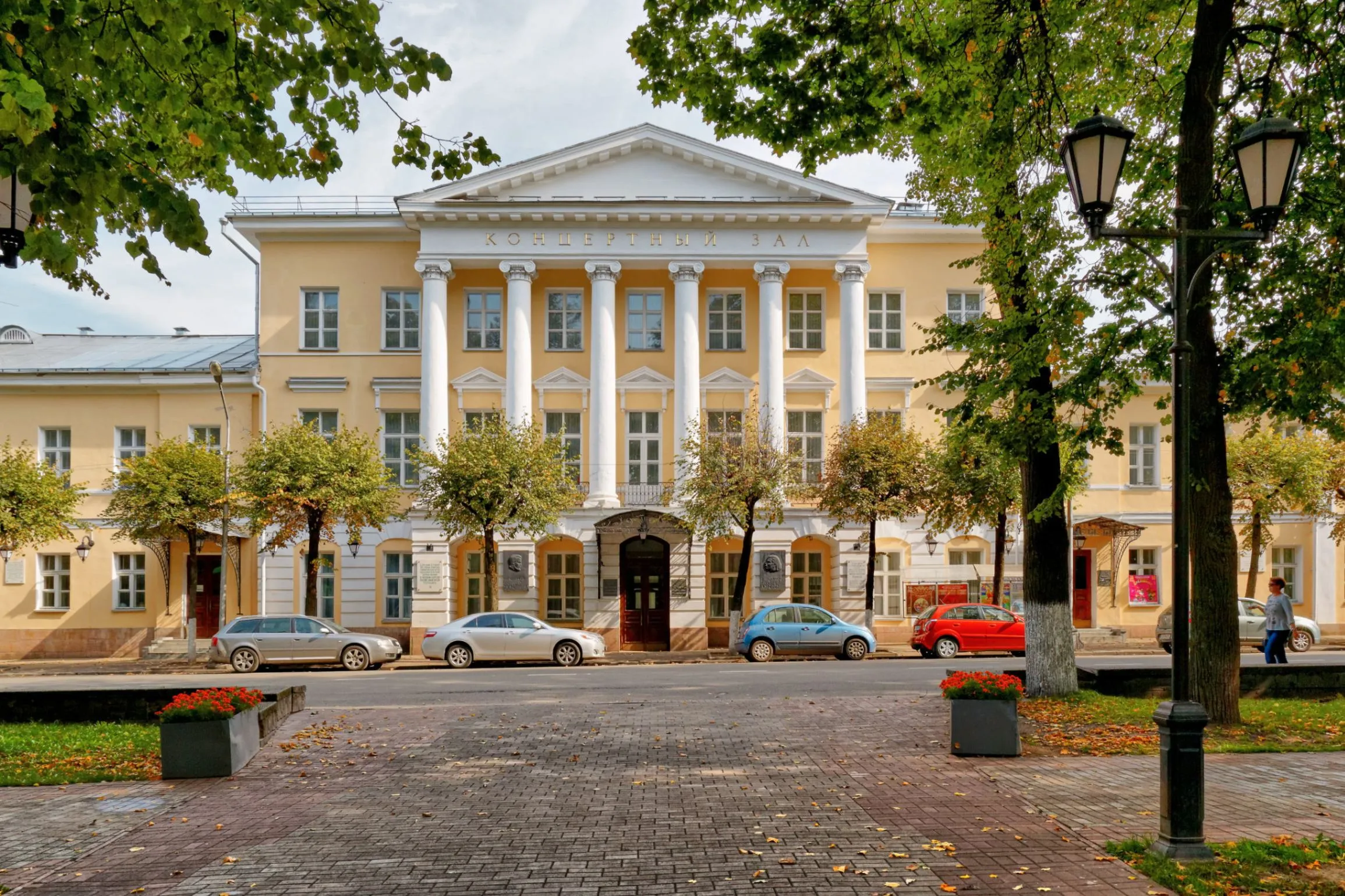
The House of the Nobility Assembly is one of the finest examples of Classicism in Smolensk — a more ceremonial, "high-status" side of the city. The building was constructed in the 1820s for the Smolensk Nobility Society. Its architecture is typical of grand public buildings of that era: a strict symmetrical facade, a tall columned portico, and a wide pediment.
In the 19th century the social life of the city played out here: balls, musical evenings, gatherings of the nobility, and concerts. Today the building is occupied by the philharmonic hall. The large concert hall is still known for its excellent acoustics, and contemporary music now fills those same historic interiors.
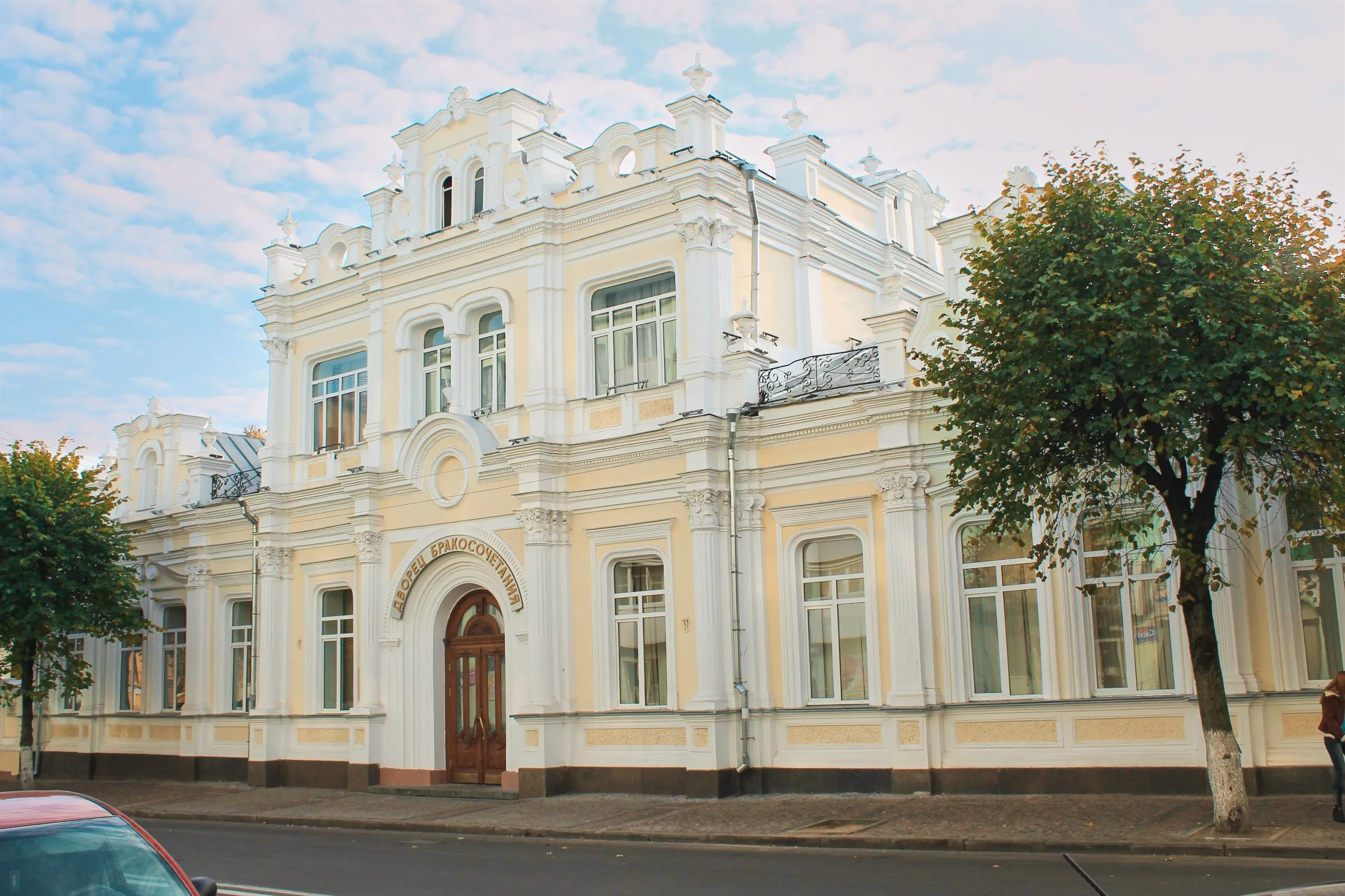
The Engelhardt House is one of the most ornate mansions in the city center. Baroque motifs, decorative plasterwork, shaped window surrounds, and richly ornamented facades. The house was built in 1878–1879 for city mayor and chamber-junker Alexander Platonovich Engelhardt.
After the revolution the fate of the mansion changed dramatically. In 1918 the Smolensk Provincial Executive Committee was housed here, and later various Soviet institutions occupied the building. The interiors were partially reworked into administrative offices, but the main ceremonial elements — staircases, plasterwork, and decorative halls — were preserved.
Today the mansion houses a registry office. Thanks to this, the building is once again connected to important events in the life of the city: only where the 19th century saw the city elite gathering, people now come to register their marriages.
Constructivism and the postwar 'showpiece city'
In the city center you can clearly see how Smolensk was rebuilt from scratch after the war, complete with new squares, administrative landmarks, cinemas, and theaters.
The Paris Commune Tower House (communal house, 'the teapot')
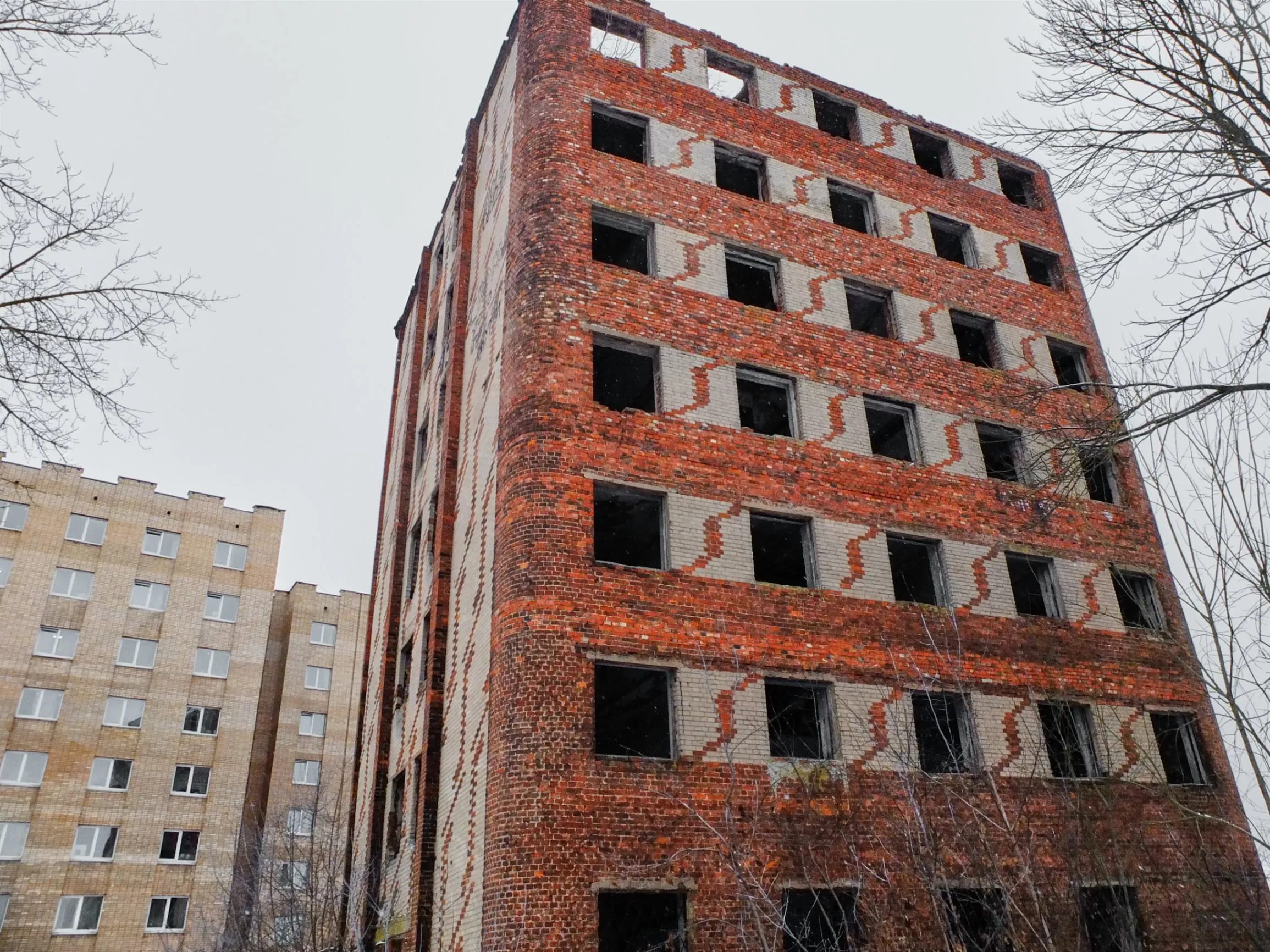
The Paris Commune House was built between 1931 and 1933 to a design by architect Oleg Vutke. The building was conceived as a communal house in which architecture served a new model of living: shared spaces — a canteen, laundry, rooms for collective leisure, and long corridors. The idea was to minimize 'private' life and move everyday domestic activities into the public sphere. There were no full kitchens — residents were expected to use the communal dining room. Over time the concept failed to take root, and the building was gradually adapted for ordinary residential use. The house has a complex configuration: seen from above and on engineering plans it resembles a teapot with a 'spout' and a 'handle,' which is how it got its nickname. In its day the seven-storey building was the tallest in the city. Today Smolensk's principal monument of constructivism stands empty and is falling into ruin. No one lives there.
Administration of the Smolensk Oblast
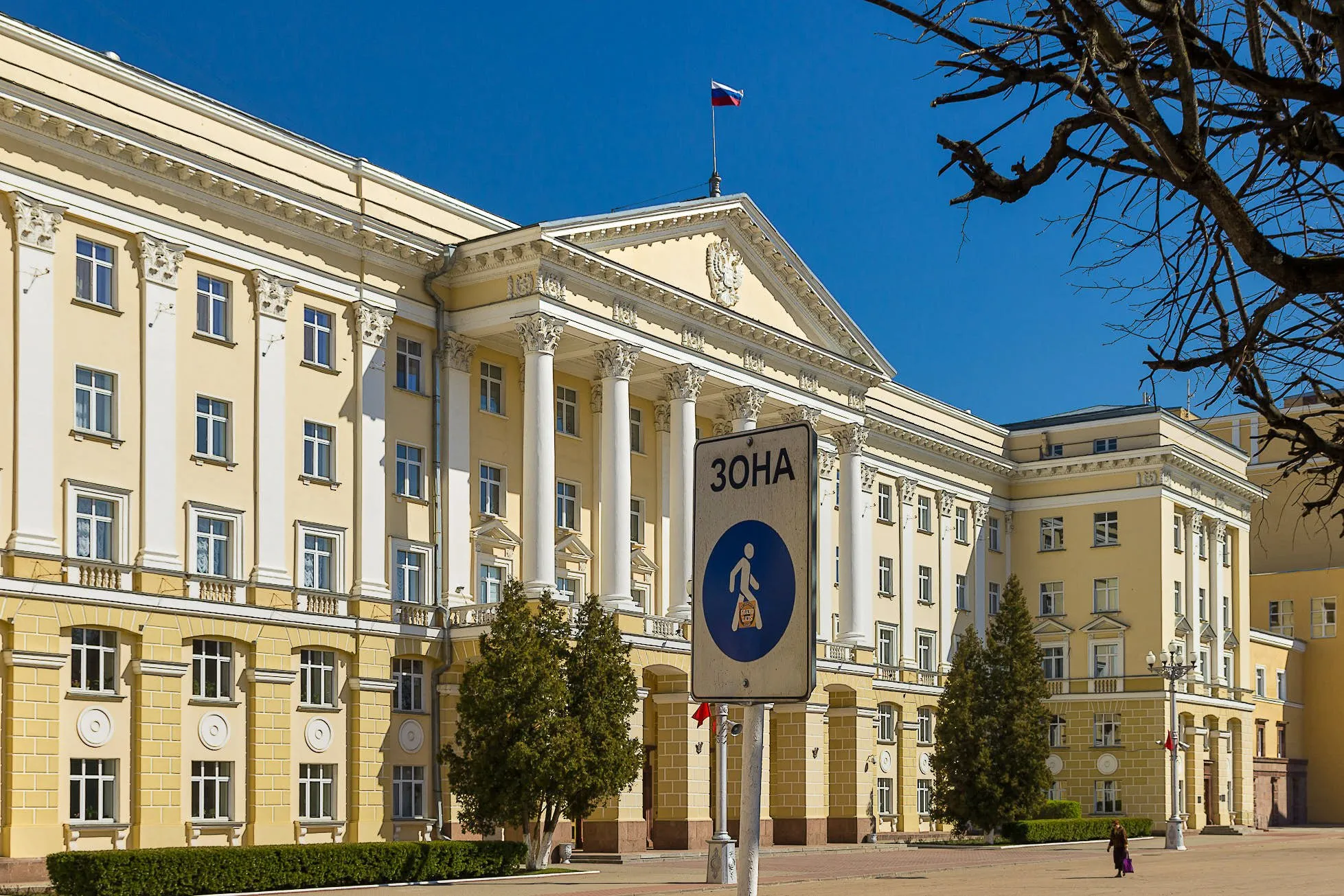
The House of Soviets was designed as the principal administrative center around which a new Lenin Square would be built. Construction began in 1931 to a design by architect Sofya Ilyinskaya, and the building stood out immediately for its scale: an elongated symmetrical facade, a tall central volume, broad entrance staircases, and a rhythm of identical rectangular windows. The prewar design still carried a constructivist austerity — almost no superfluous decoration, with an emphasis on geometry and mass.
During the Great Patriotic War the building was severely damaged and was restored in the postwar years. The architecture acquired a Soviet neoclassical character with a ceremonial facade, even though the main volume and structural form of the building remained constructivist.
Drama Theater
The drama theater building on Lenin Square was designed from the outset as part of the square's ensemble rather than as a standalone structure. The theater's architecture is considerably more complex than it appears at first glance. The building was constructed between 1935 and 1939 to a design by architect Sofya Ilyinskaya and combines simple geometric forms with detailing in a neoclassical 'imperial' style.
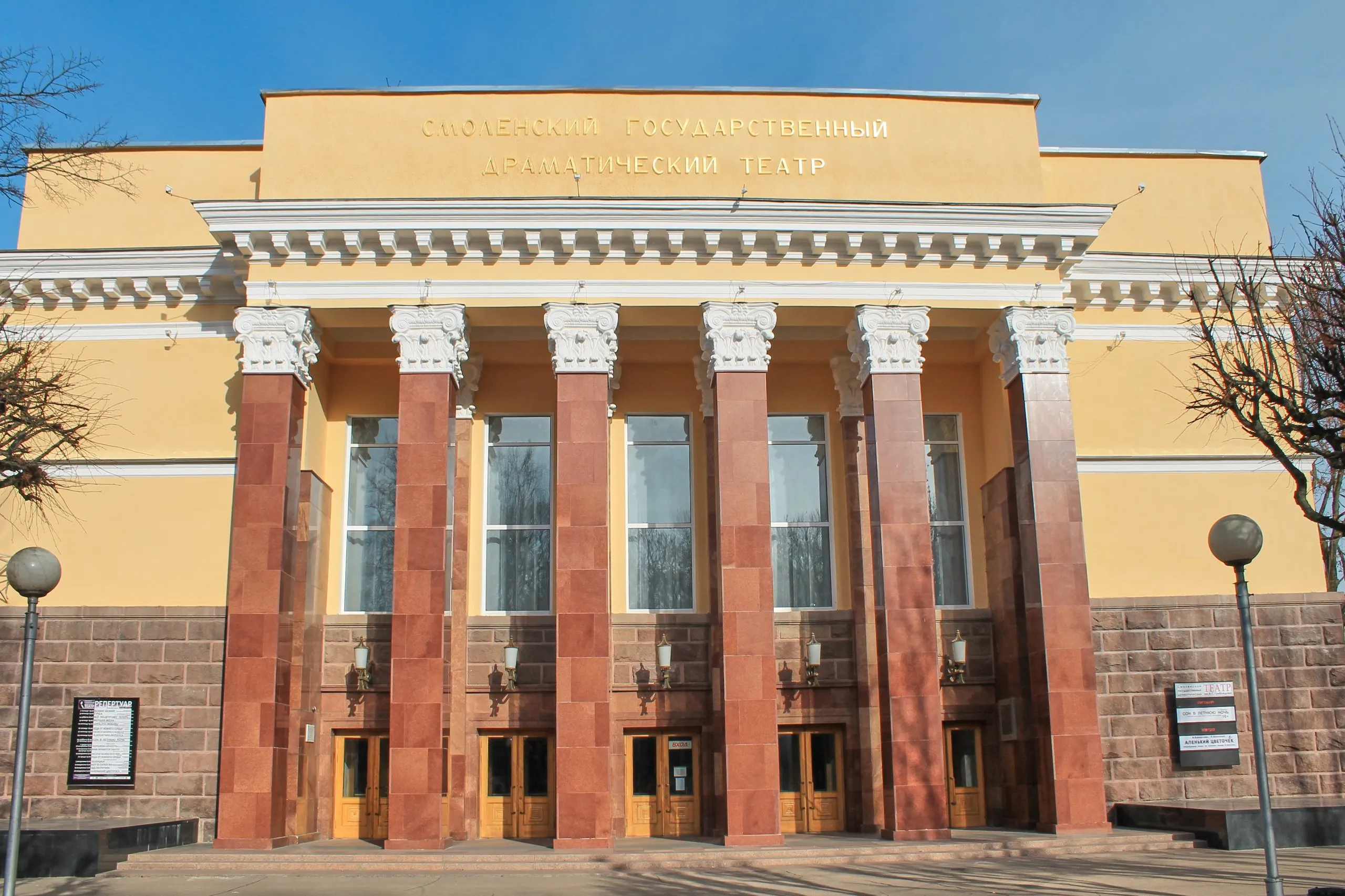
The main facade is framed by a projecting six-column portico behind which the grand entrance is located. A two-tiered colonnade runs around the central oval hall, to which the staircase blocks and the stage are attached. The building is composed as a precise arrangement of several geometric forms: an oval auditorium, a rectangular stage block, and projecting staircase risalits.
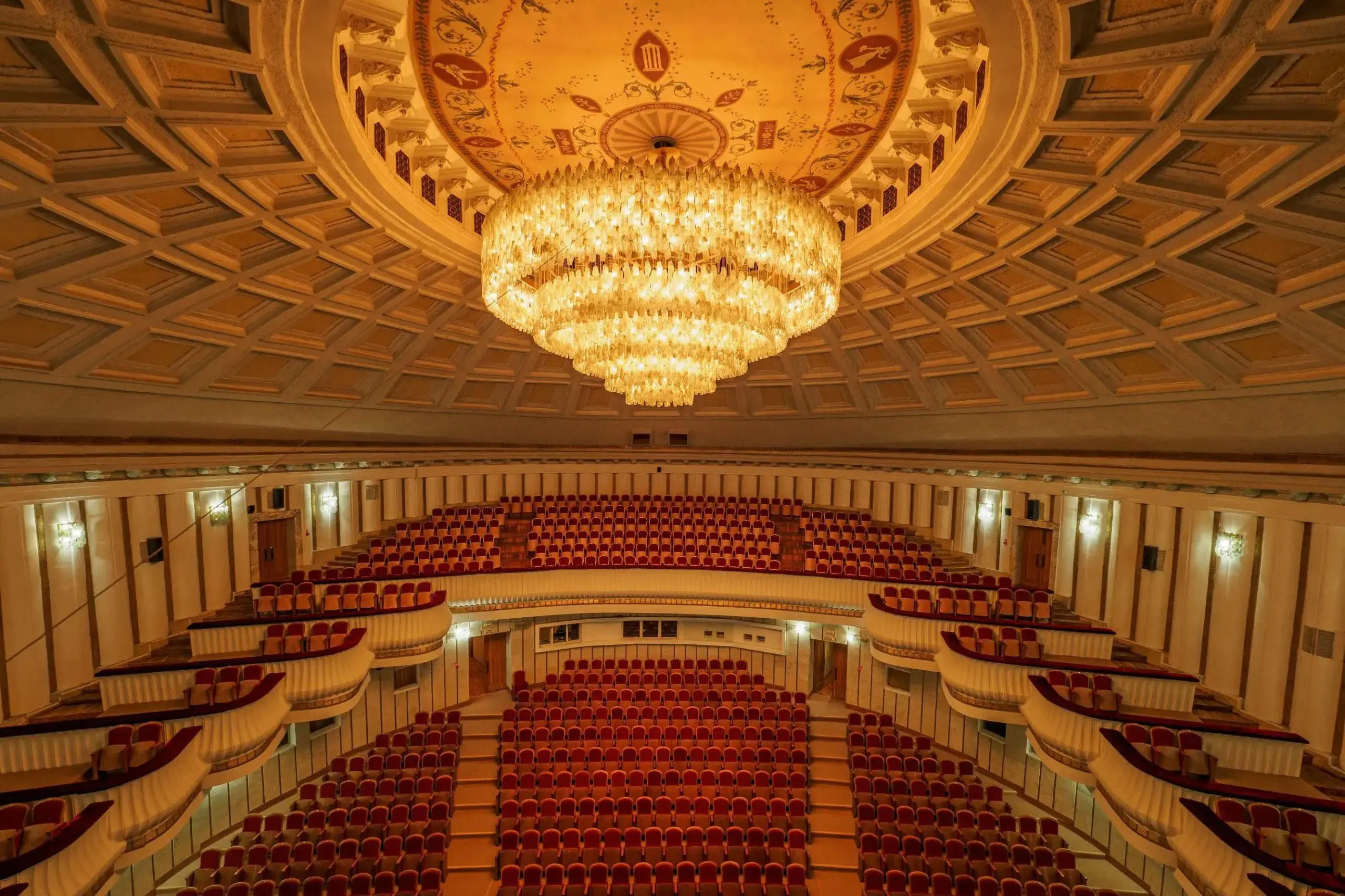
The auditorium seats approximately 800 to 900 people and is laid out according to the classical theater scheme: stalls, a balcony, and side boxes arranged in tiers. The space is covered by a monolithic dome with painted decoration, and circular foyers run around the hall like a closed circuit for the audience. Notably, the dome is built as a thin reinforced-concrete structure — an engineering bold choice for its time.
October Cinema
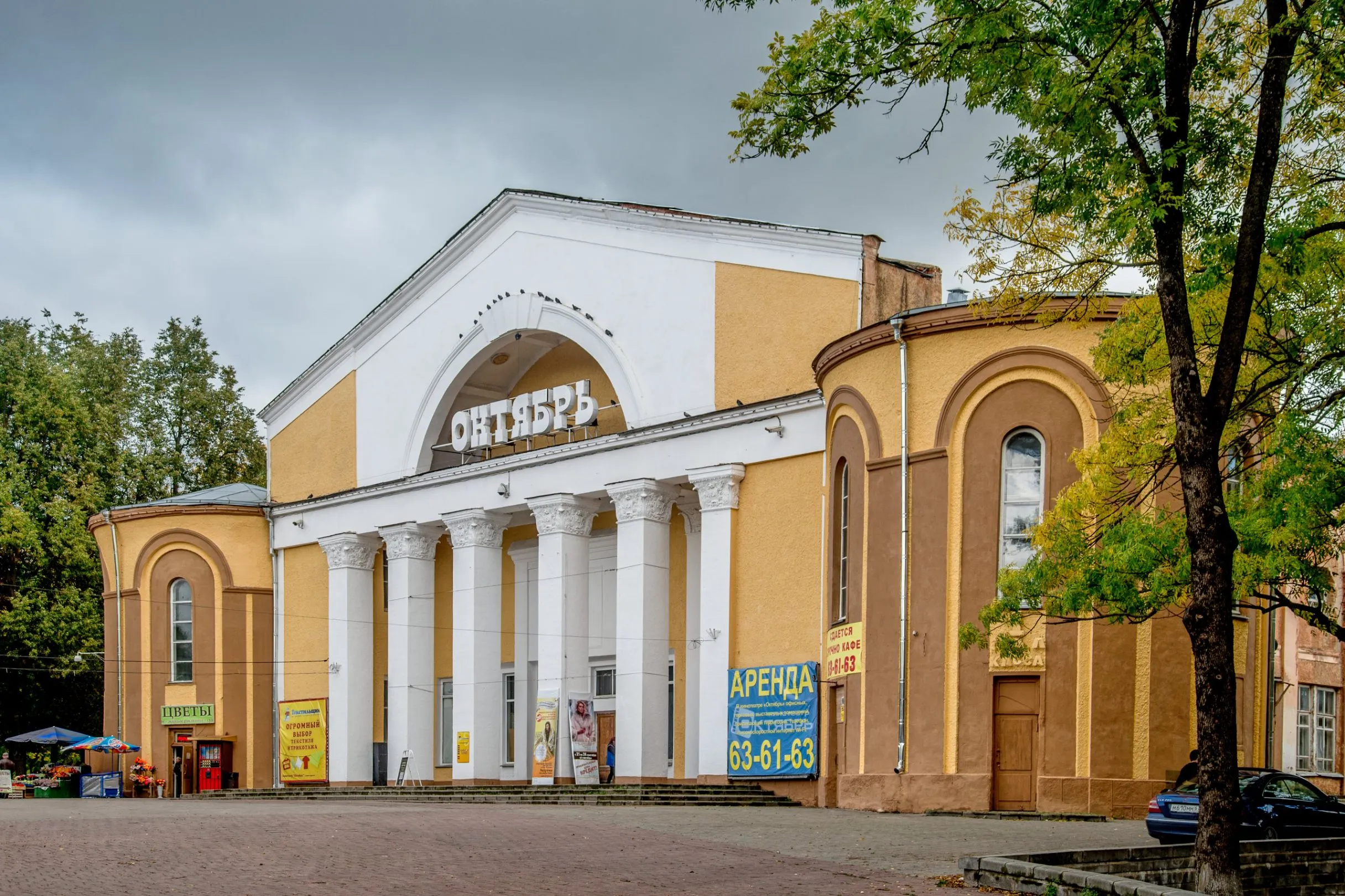
The October Cinema opened in 1948 — it is one of the first major public buildings constructed in Smolensk after the city's liberation. In the Soviet era it was used not only for film screenings but also for mass events: meetings with public figures, exhibitions, and fairs. The interiors are decorated with the ceremonial grandeur typical of the postwar period: spacious halls, broad staircases, and an abundance of ornamental detail.
Old Facades, New Purposes
In Smolensk, it is worth looking not only at what has survived, but also at how old buildings continue to live on in new roles. Former churches, factories, fire stations, and assembly halls have organically woven themselves into the fabric of ordinary city life.
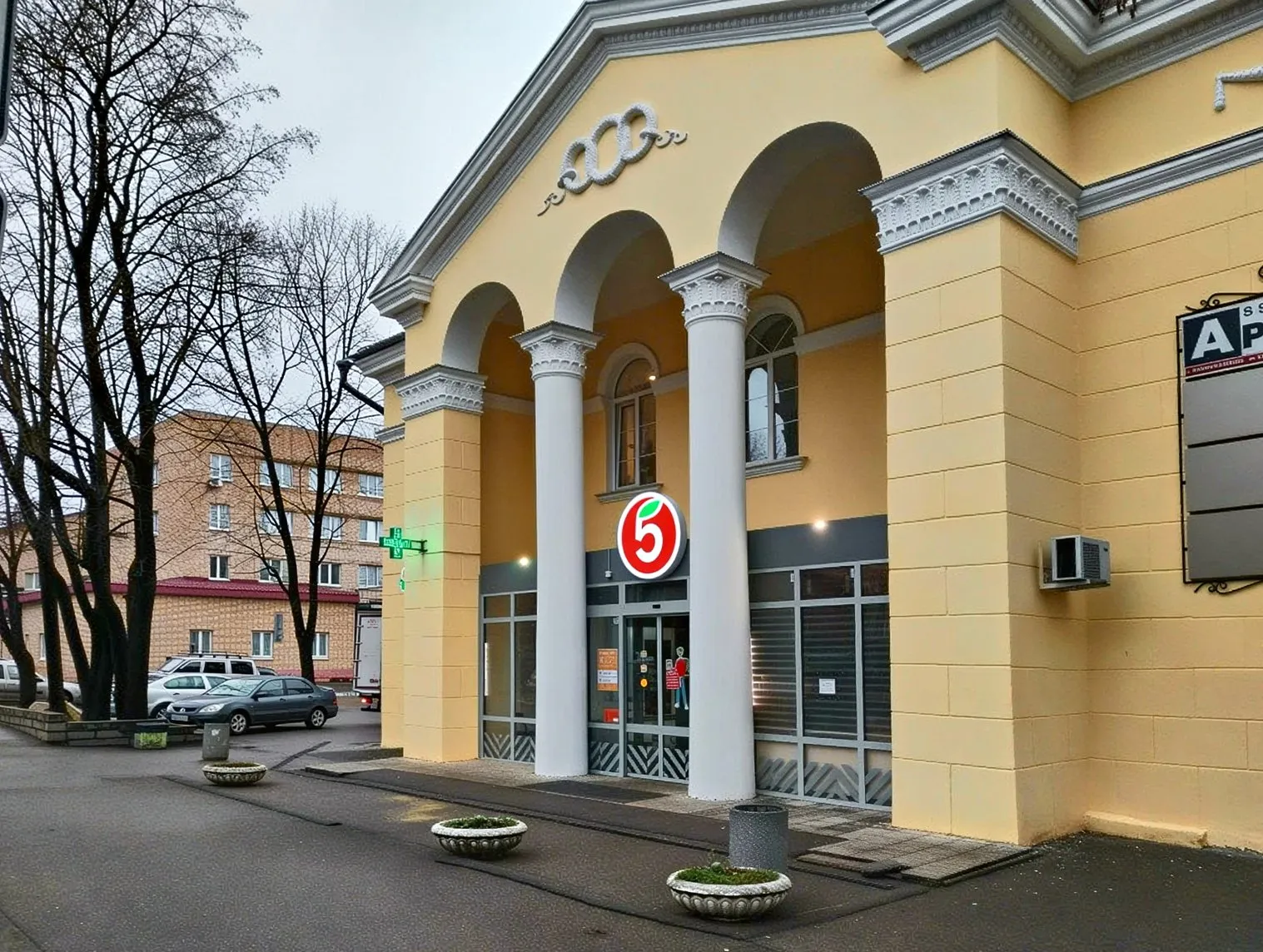
In one of the buildings that once housed the House of Culture of the Deaf, a Pyaterochka supermarket has since opened — a move that was widely discussed in local community pages and media outlets after it launched. On the outside, the building retains the characteristic features of a Soviet house of culture. Inside, the space has been completely rebuilt to fit the standard format of a chain retailer, complete with a sales floor, checkout lanes, and shelving units.
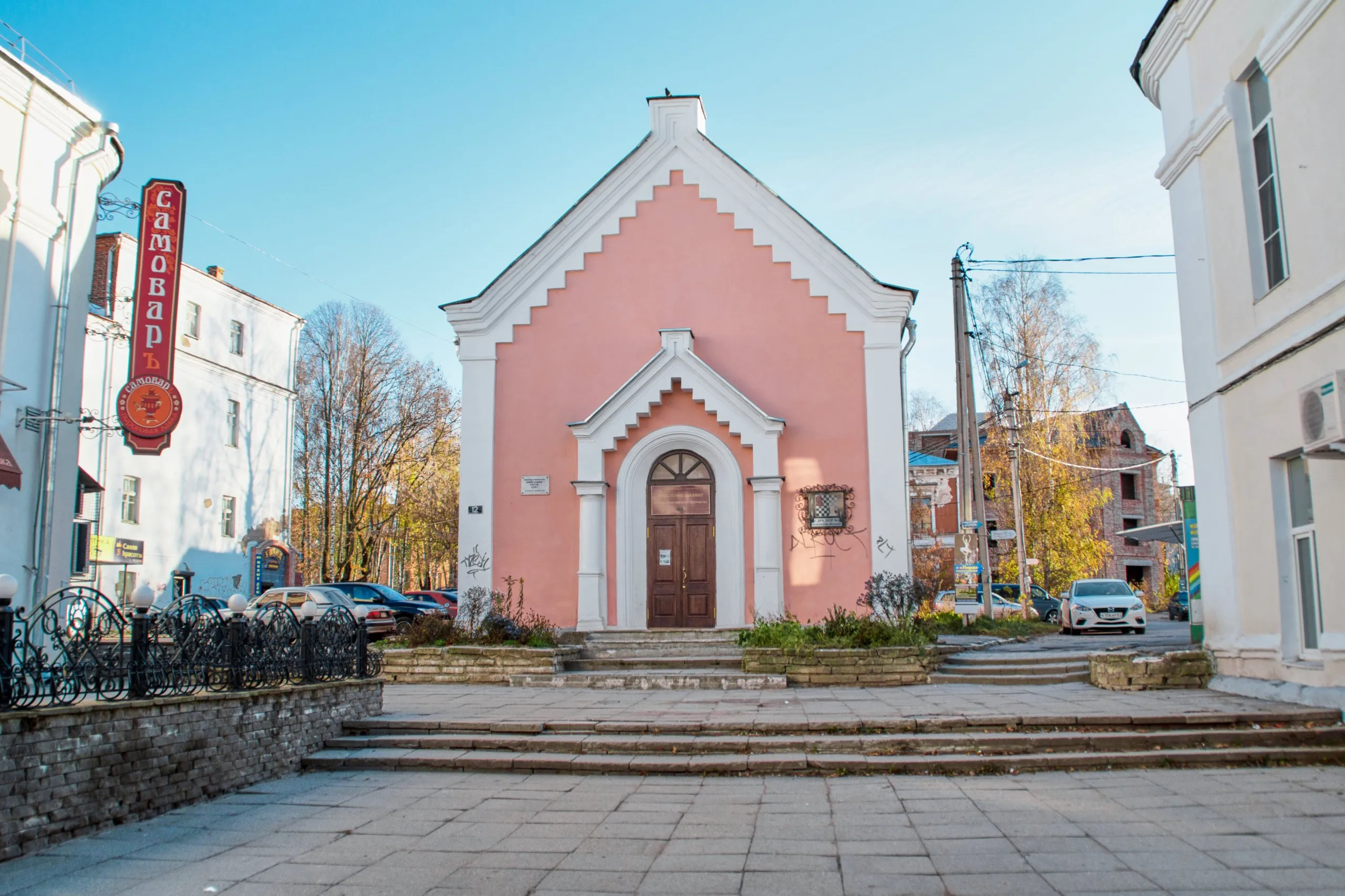
The Lutheran Church was built for the city's German community. During the Soviet era the church was closed, and the building was taken over by a chess club — hence its unofficial nickname, the "chess cottage."
The building of the first fire station was eventually converted into a residential building. Originally it was a service complex with gates for fire crews to drive out through and utility spaces. It was later adapted for housing, and today it is an ordinary apartment building in which the traces of its former structure can still be made out — large openings and a utilitarian layout.
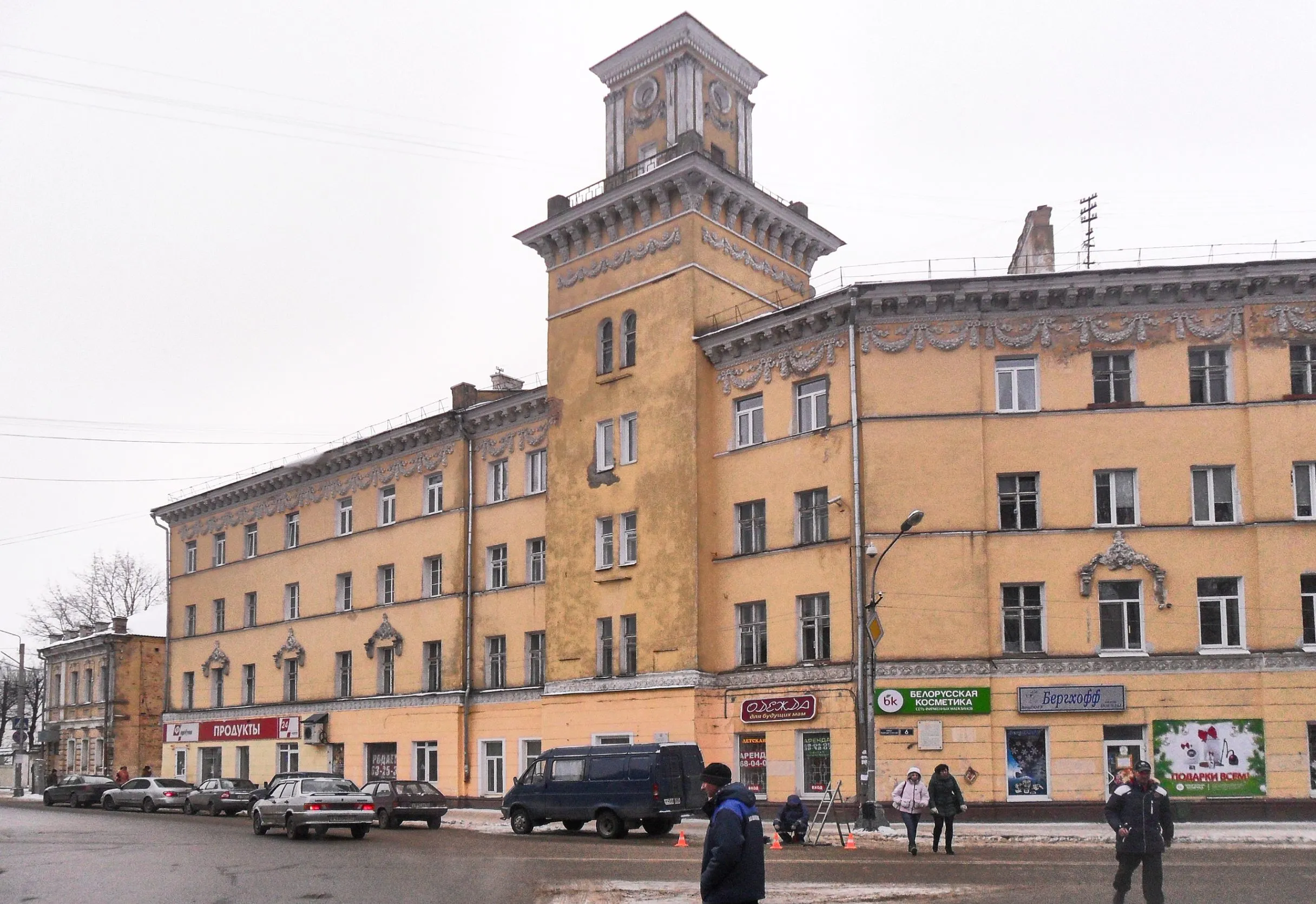
Attached to the building of the former City Duma is a fire watchtower. This was a typical feature of pre-revolutionary Russian towns: the tower was used to watch for fires and send signals. Today the tower remains as an architectural detail, serving as a visual landmark in the urban landscape.
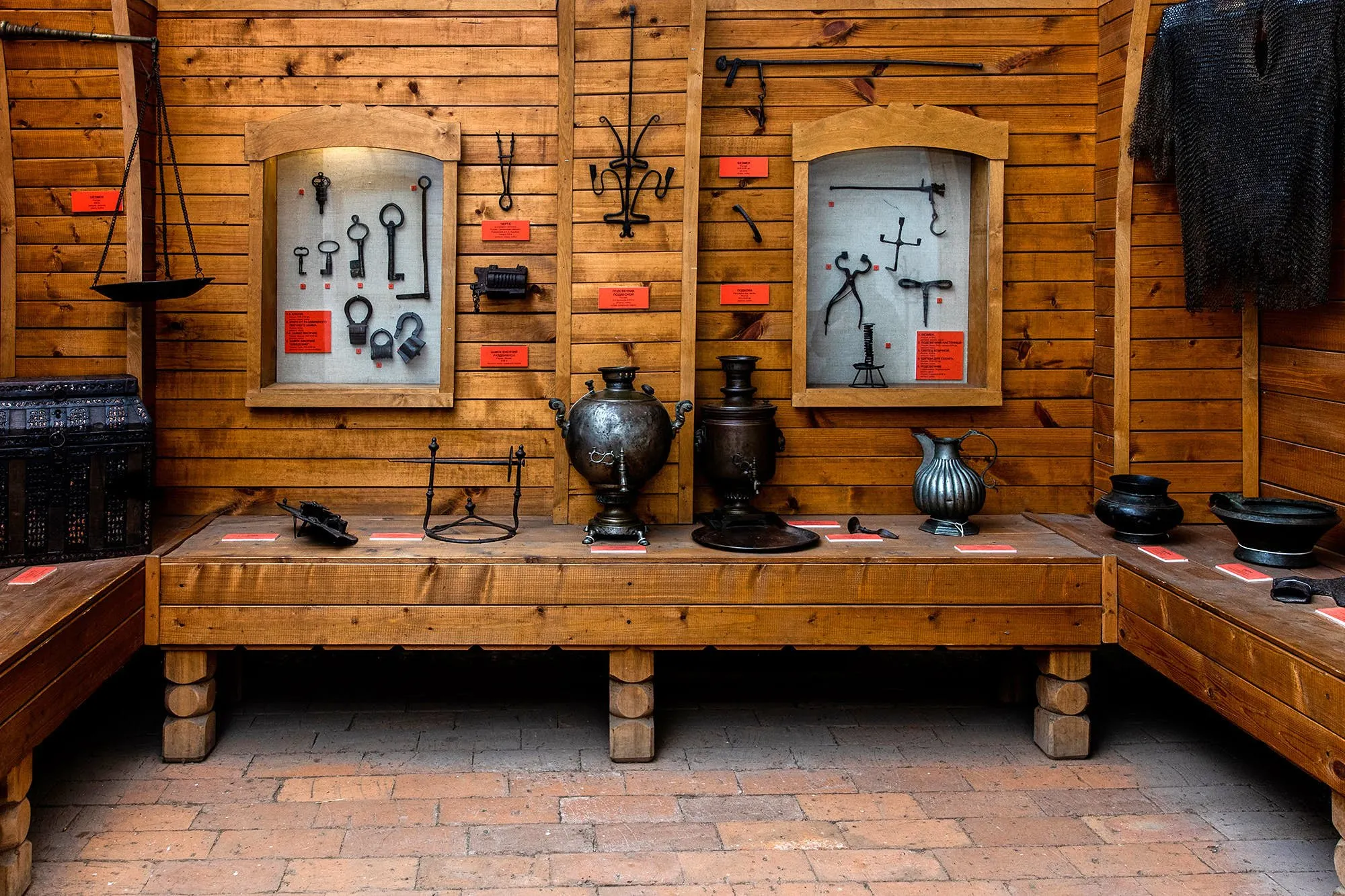
At 10a Lenina Street stands a rare surviving example of 17th-century residential architecture in Smolensk, built during the Polish period. A forge operated here at various points in its history, and today the building houses the museum "Smolenskaya Kuznítsa" (Smolensk Forge), dedicated to the traditions of blacksmithing.
The building that in the 19th century housed the distillery of the merchant Machulsky, today is occupied by a bar 1865 . The industrial function is gone, but the connection to it endures: people still gather here, and drinks are still made on the premises. It is a rare case where a new use does not contradict the historical logic of a place, but continues it.
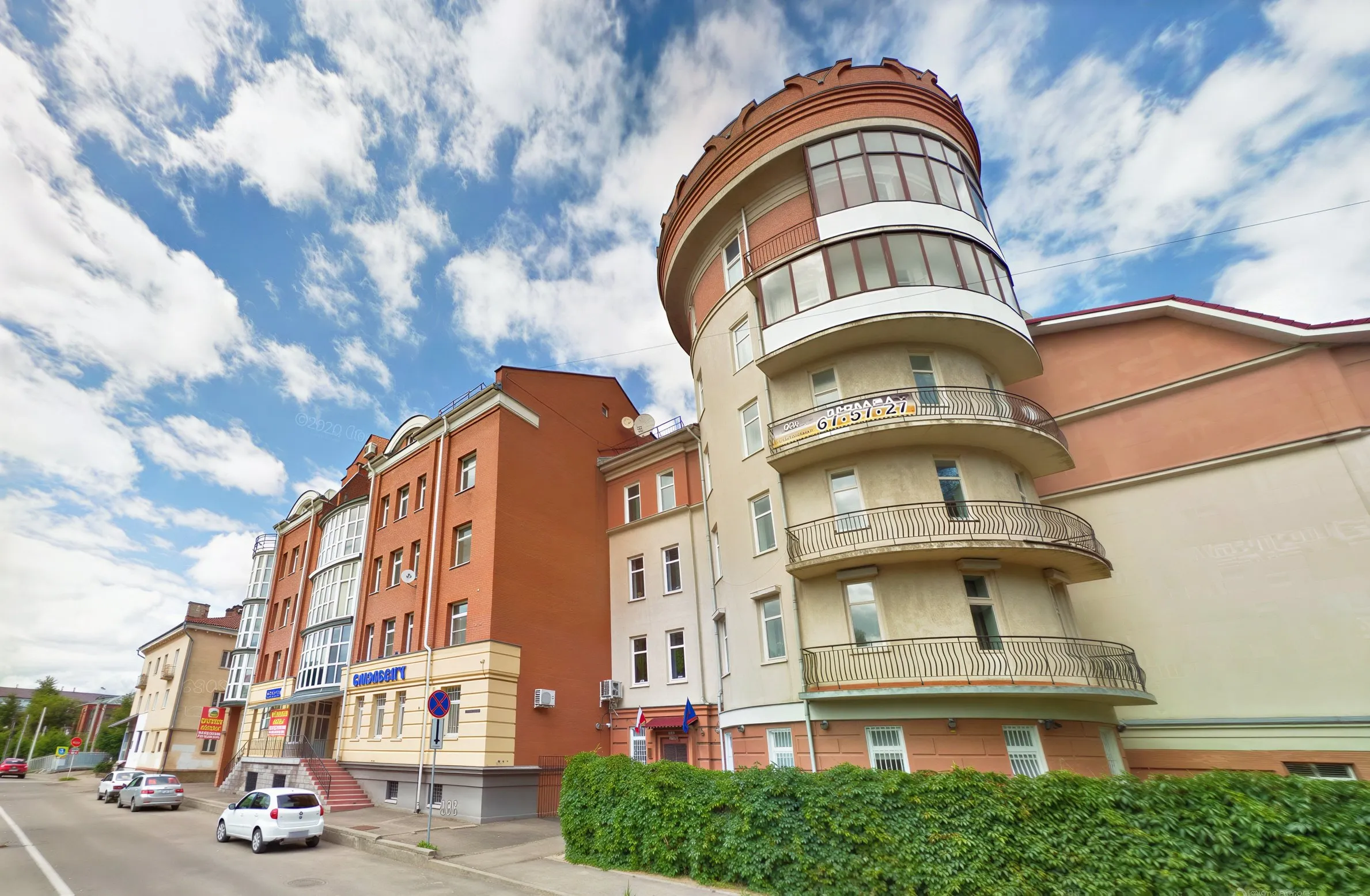
The water tower at 1 Mira Street was converted into a residential building in the 2000s. The cylindrical volume of the tower was preserved, with windows and residential floors added. Apartments were installed inside, and the former reservoir was repurposed as living space.
Best Views of the City
Almost all the best views in Smolensk are not observation platforms in the conventional sense, where you look down on a city from above, but rather points along changes in elevation where the city "opens up" across the hillsides.
From Valutina Gora you get one of the most "readable" views of the Dnieper's bend. The river channel, the opposite bank, and the way the historic center is laid out across the slopes are all clearly visible. From here it becomes obvious that the city literally "holds on" to its changes in elevation.
The viewpoint on Kozlov Street shows Smolensk differently, without a wide panorama. From the memorial to fallen prisoners of war, the Assumption Cathedral is visible. Walk about 100 meters toward Konenkov Street and the Blonie Garden comes into view, and if you descend roughly 150 meters toward Bolshaya Sovetskaya, it becomes especially clear how the streets run on a slope, how buildings are set into the hillside, and where retaining walls and level changes appear between the courtyards.
Take a walk along the Dnieper embankment. This is the view from below: you can clearly see how high the right bank rises, with the city center occupying it, the line of the fortress wall along the slopes, and the silhouettes of churches along the ridgeline. From this vantage point the contrast between the water level and the city's skyline above is especially striking.
From sections of the fortress wall and its towers you get a rare perspective — looking along the line of the fortifications themselves. You can see how the wall stretches through city blocks, crosses roads, and meets modern streets. In some places you can literally trace where the boundary of the old city once ran.
Museums
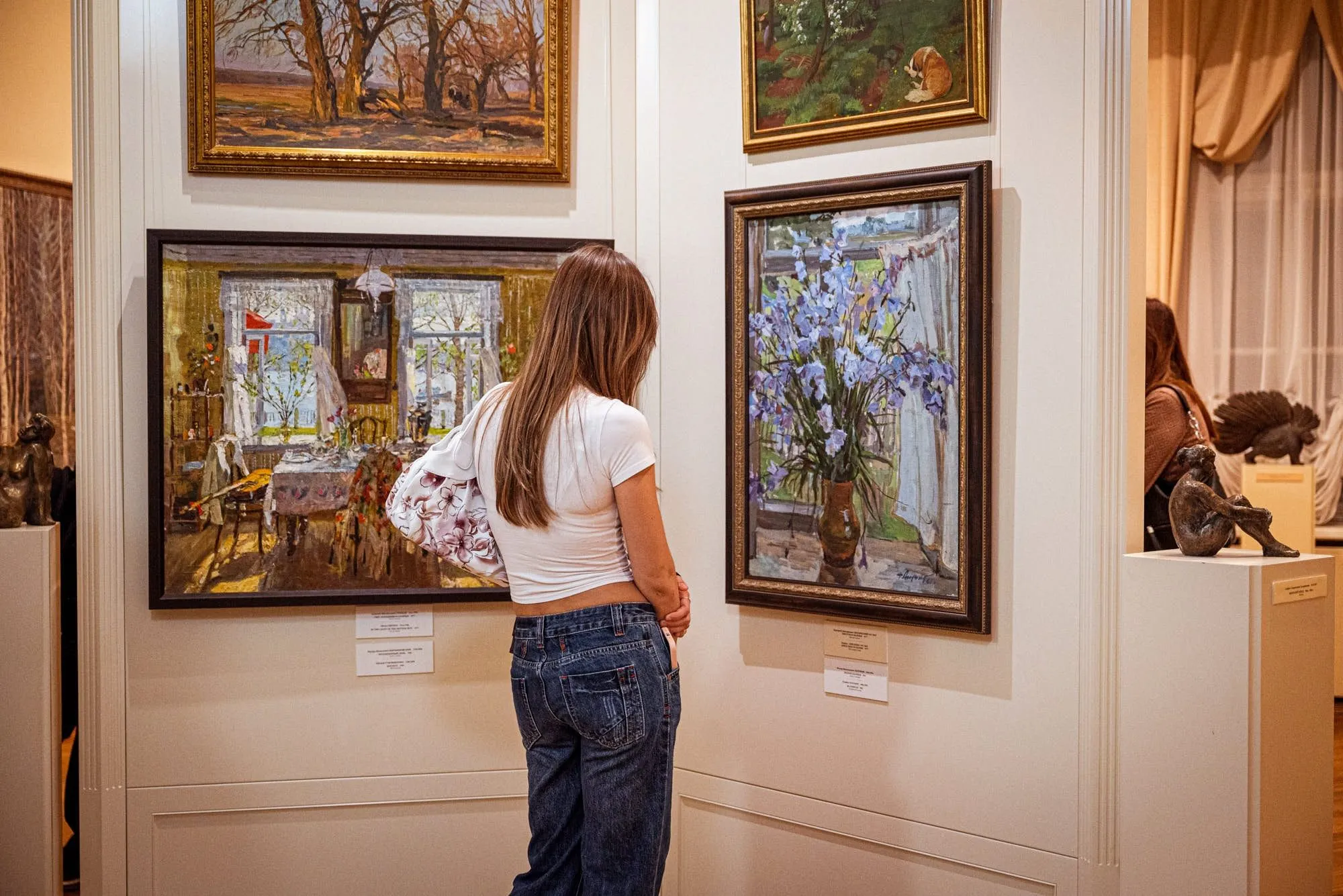
Art Gallery is housed in the former Alexander Real School, built between 1877 and 1880. The symmetrical façade, rhythm of tall windows, and austere cornices convey the academic seriousness typical of educational institutions of that era. The building faces the quiet Kommunisticheskaya Street.
The collection features Russian painting from the 18th to 20th centuries, including works by Aivazovsky, Shishkin, Levitan, Repin, Kuindzhi, and other masters. The high ceilings and large windows of the former school provide soft natural light, making the halls well suited for museum displays. Admission is 450 rubles (5.31 USD).
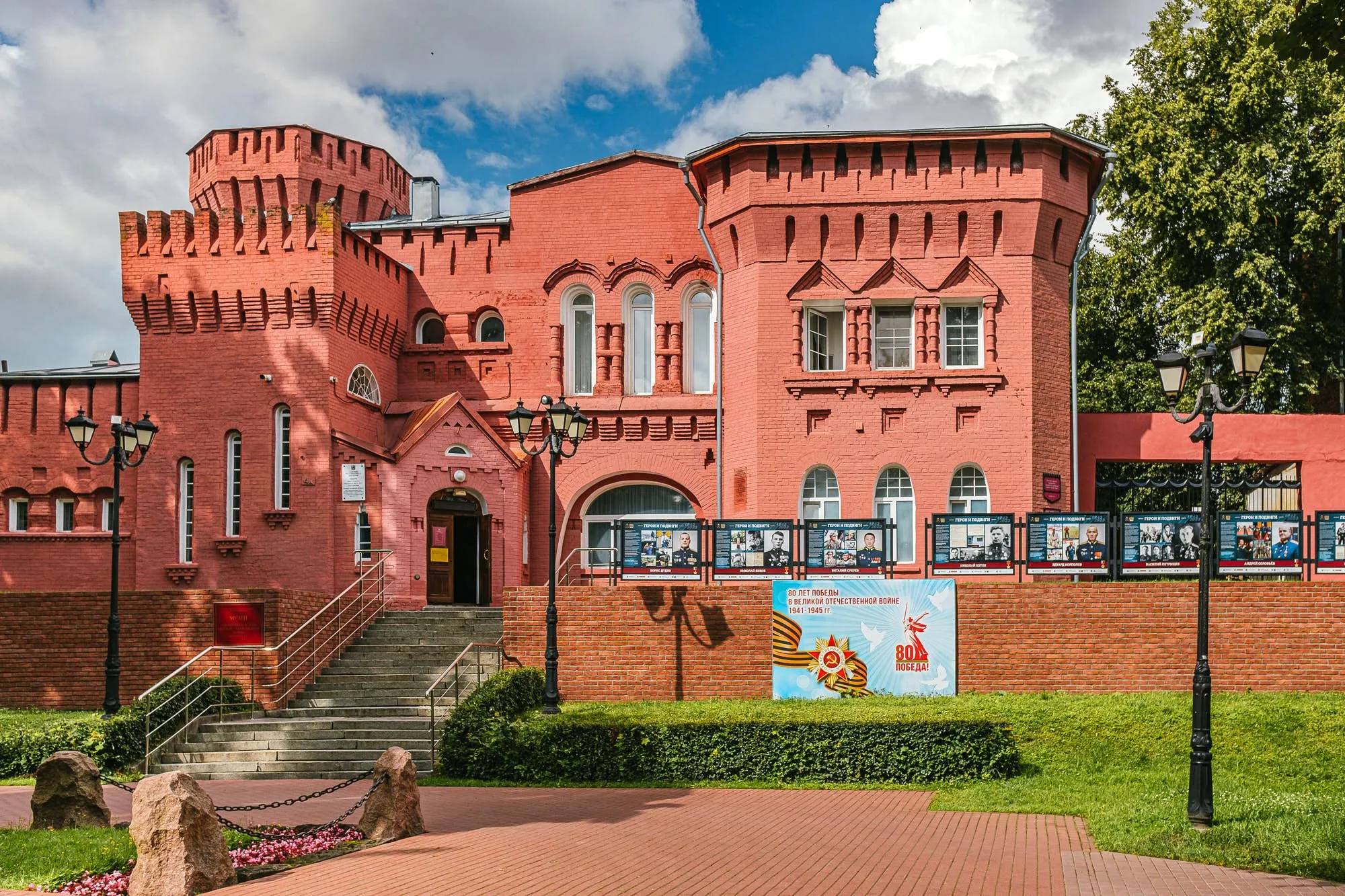
Museum "Smolenshchina During the Great Patriotic War of 1941–1945" is located in a building constructed in 1912 for the municipal school "In Memory of 1812." After severe damage sustained during the fighting for Smolensk in 1941–1943, the building had to be almost entirely rebuilt.
The exhibition covers the Battle of Smolensk in 1941, the partisan movement, and the liberation of the city in 1943. Among the exhibits are authentic military equipment, weapons, documents, and personal belongings of war participants. Notably, the building stands on the site of one of the towers of the Smolensk Fortress Wall, which was demolished in the 19th century; during the school's construction, part of the old foundation and fortress brickwork was reused. Admission is 250 rubles (2.95 USD).
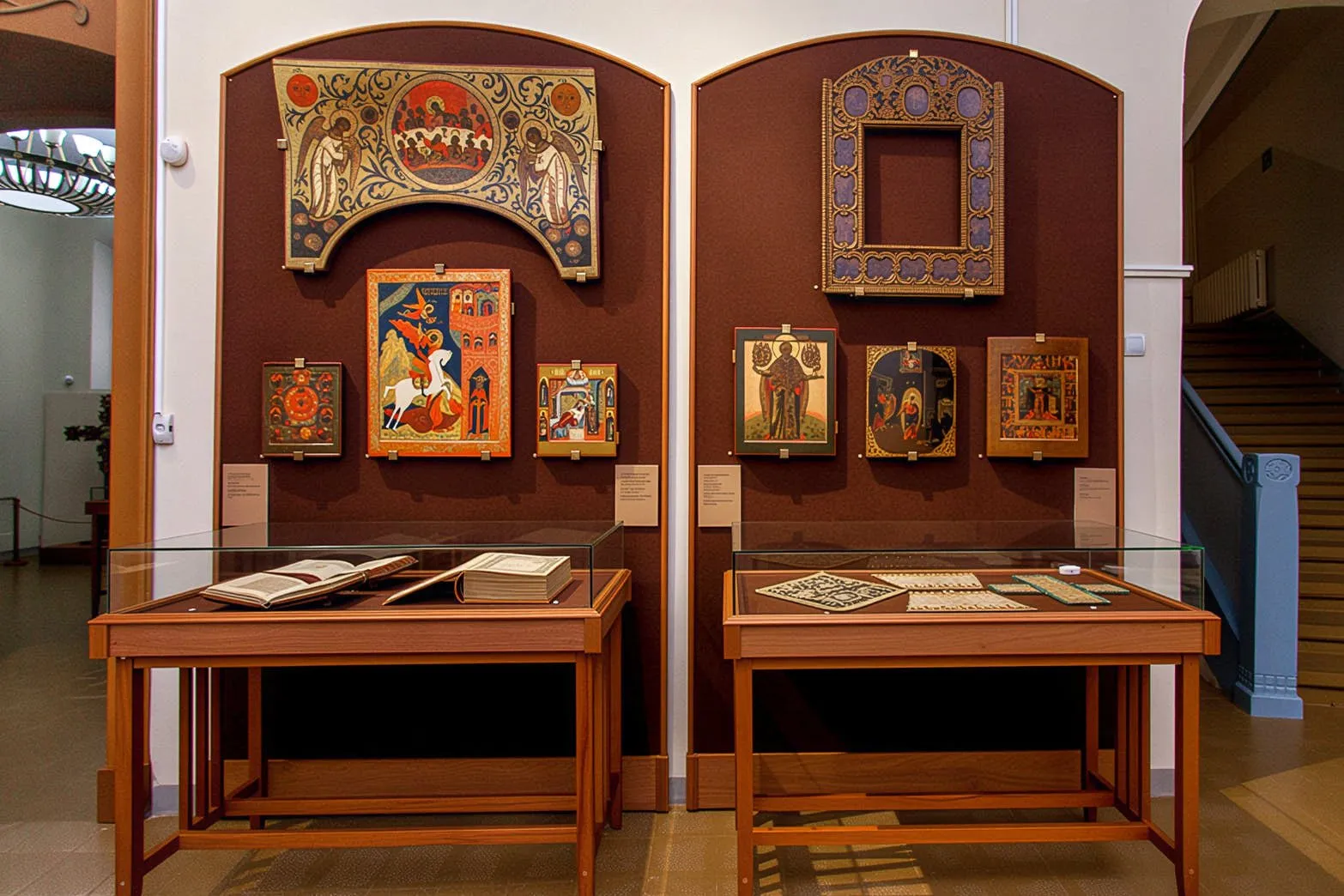
Museum of Russian Antiquity is located in a building erected in 1905–1907 at the initiative of Princess Maria Klavdievna Tenisheva, a noted patron of the arts and collector of folk art. The building's architecture is executed in the Neo-Russian style: the façades are decorated with ornamental brickwork, patterns, and elements inspired by ancient Russian architecture. The house was conceived from the outset as a museum for Tenisheva's collection, so its exterior resembles both an urban building and a stylized traditional mansion.

In the early 20th century, the museum housed one of the most celebrated folk art collections in Russia: ancient icons, wood carvings, embroideries, peasant household objects, and archaeological finds. The collection was shown not only in Russia — some exhibits were displayed in Paris and other European cities. After the revolution, the museum underwent several reorganizations, but the building survived and today operates as a museum once again. Admission is 250 rubles (2.95 USD).
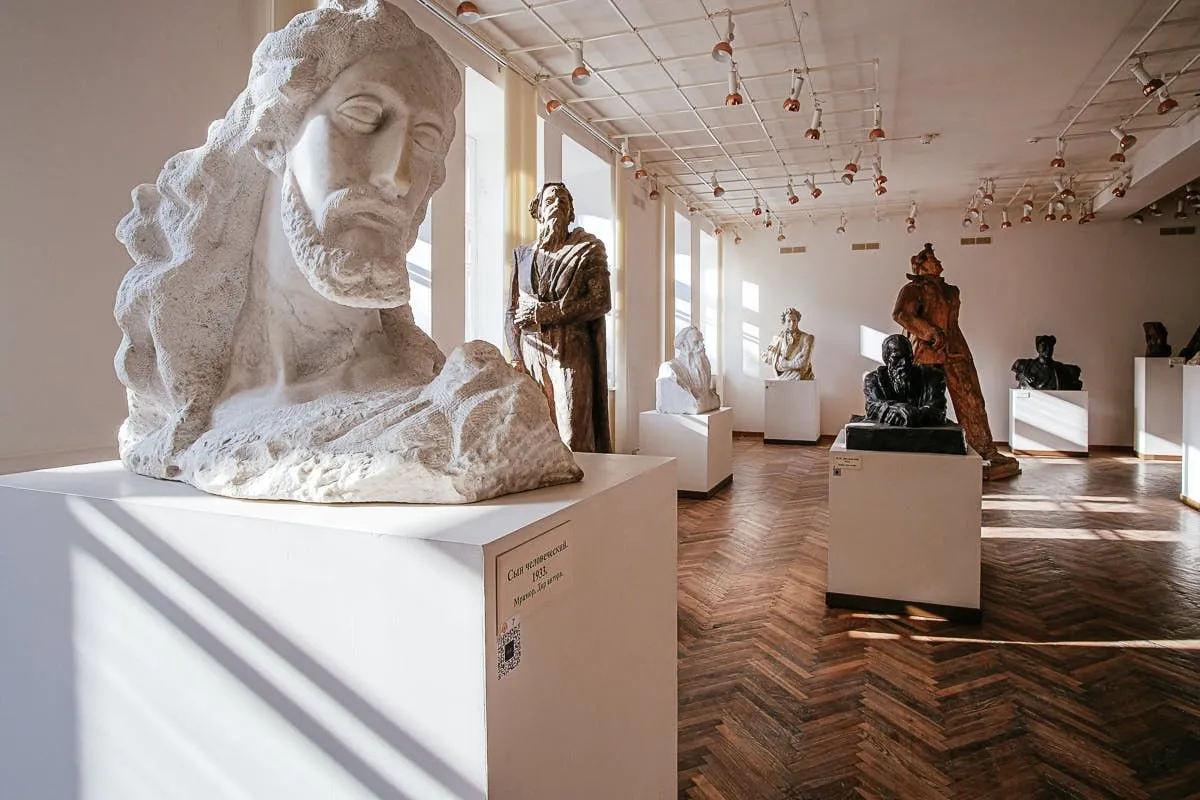
Museum of Sculptor Sergei KonenkovThe building at 7 Mayakovsky Street has changed its function several times over its history. It originally housed a bank, later a kindergarten, and today operates as a museum. Throughout these changes, the building's architecture remained largely unaltered: the classical volume and façade stayed the same while the interior was adapted each time to suit the new purpose. The sculpture museum opened in 1973 with the participation of the master Sergei Konenkov himself, and 40 works were transferred to Smolensk from his Moscow studio for the occasion. The museum holds a personal collection of Konenkov's work, ranging from intimate small-scale pieces to large compositions. Admission is 400 rubles (4.72 USD).
Parks and Nature
Blonie Garden is a 19th-century city garden right in the heart of the city. At its center stands a monument to Mikhail Glinka dating from 1885, and nearby is a bronze deer brought back after the war from East Prussia. The space is laid out in a clear, classical style: tree-lined alleys, an open square, and a symmetrical landscape.
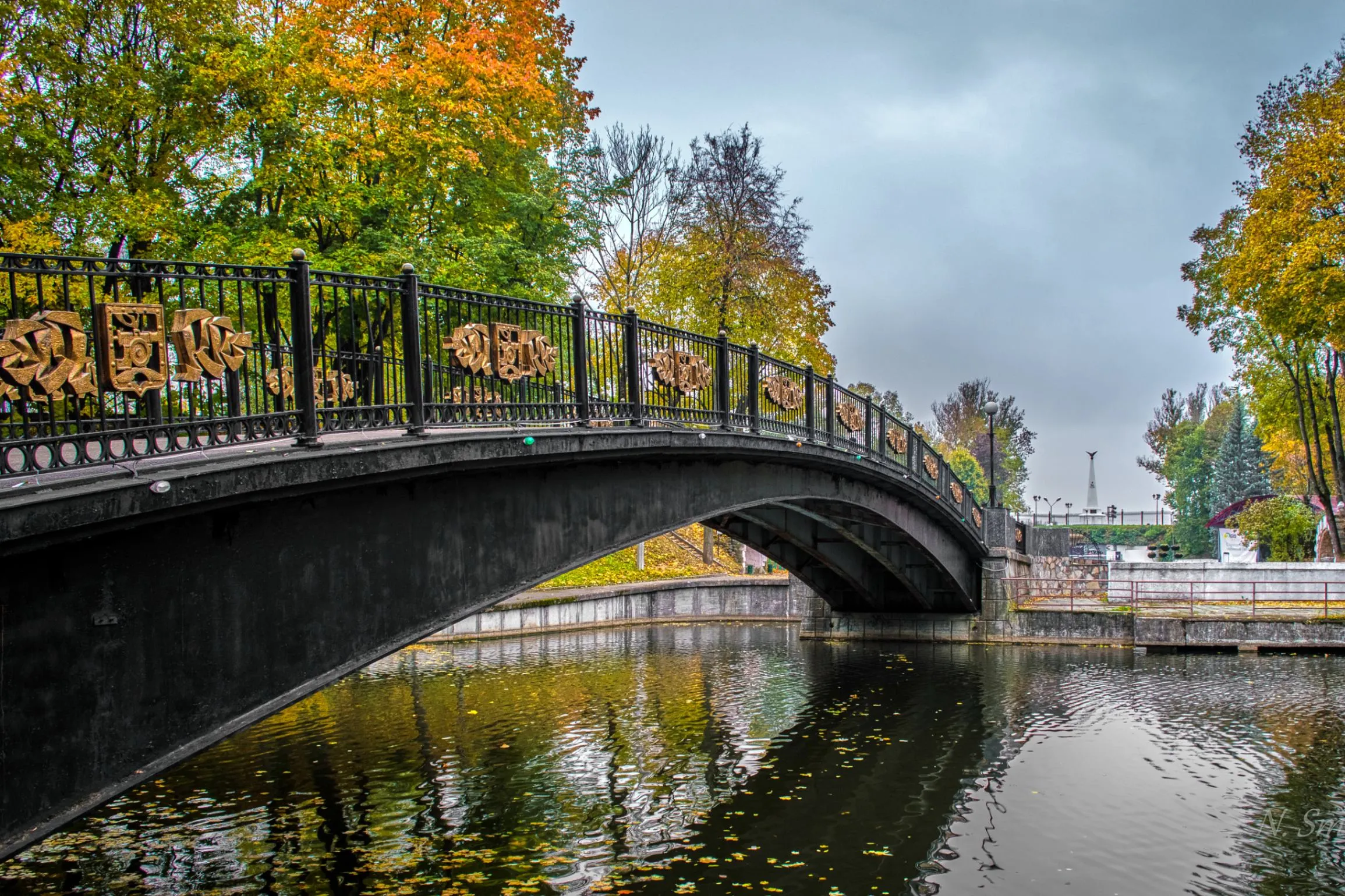
Lopatinsky Garden occupies the site of a former bastion. Walking through it, it is easy to miss the fact that part of the fortress lies hidden underfoot. The casemates here are built directly into the ramparts of the 17th-century bastion — they are not separate "dungeons" but a continuation of the defensive system. Inside the ramparts were rooms used to hold prisoners and house the garrison. Later, the entrances to these spaces were redesigned as decorative grottos with fountains and lion sculptures.
The garden itself is laid out on top of the fortress: the former moat was turned into a pond with bridges, paths and gazebos appeared on the ramparts, sculptures are dotted around the grounds, and inside the bastion there are spaces for walking and events.
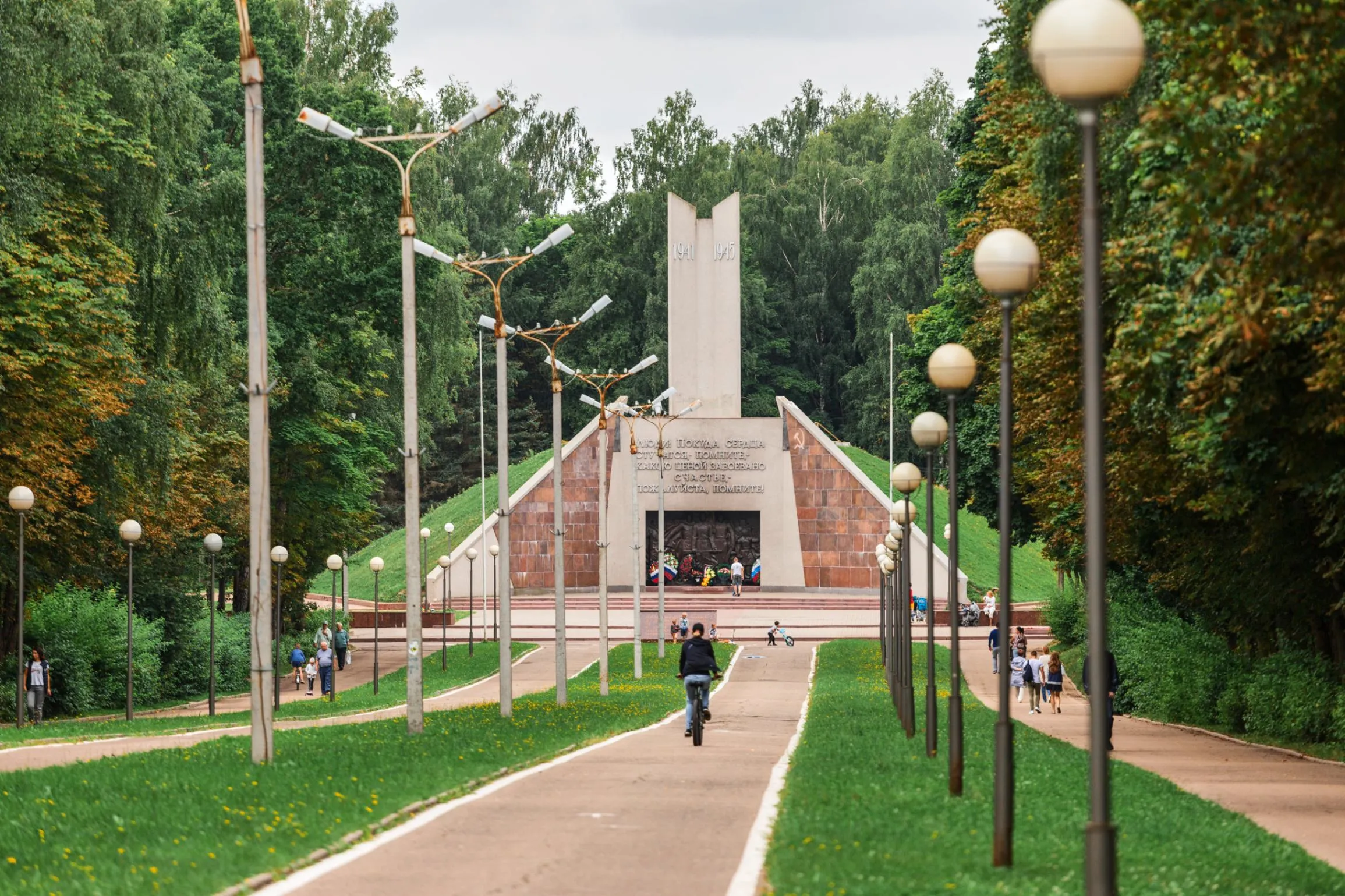
Readovsky Park is connected to the city's wartime memory. It is home to the Grieving Mother monument and the Mound of Immortality. At the same time, the park is very much alive and actively used — people come here to stroll and cycle.
The Park of the 1100th Anniversary of Smolensk is a more modern city park. It is located in a residential area, and people come here to walk, exercise, and chat on benches.
Pushkin Square Garden is a small park in the city center — an ideal spot to sit down and take a break during a walk.
Map of Attractions
Surroundings
Gnezdovo (ten kilometres from Smolensk) is an archaeological complex on both banks of the Dnieper, linked to the Viking Age and the formation of ancient Rus. Around 4,500 burial mounds have been counted on the site. People come here for the landscape itself: the mounds, the high riverbank, the river, and the sense of the ancient trade route 'from the Varangians to the Greeks'.
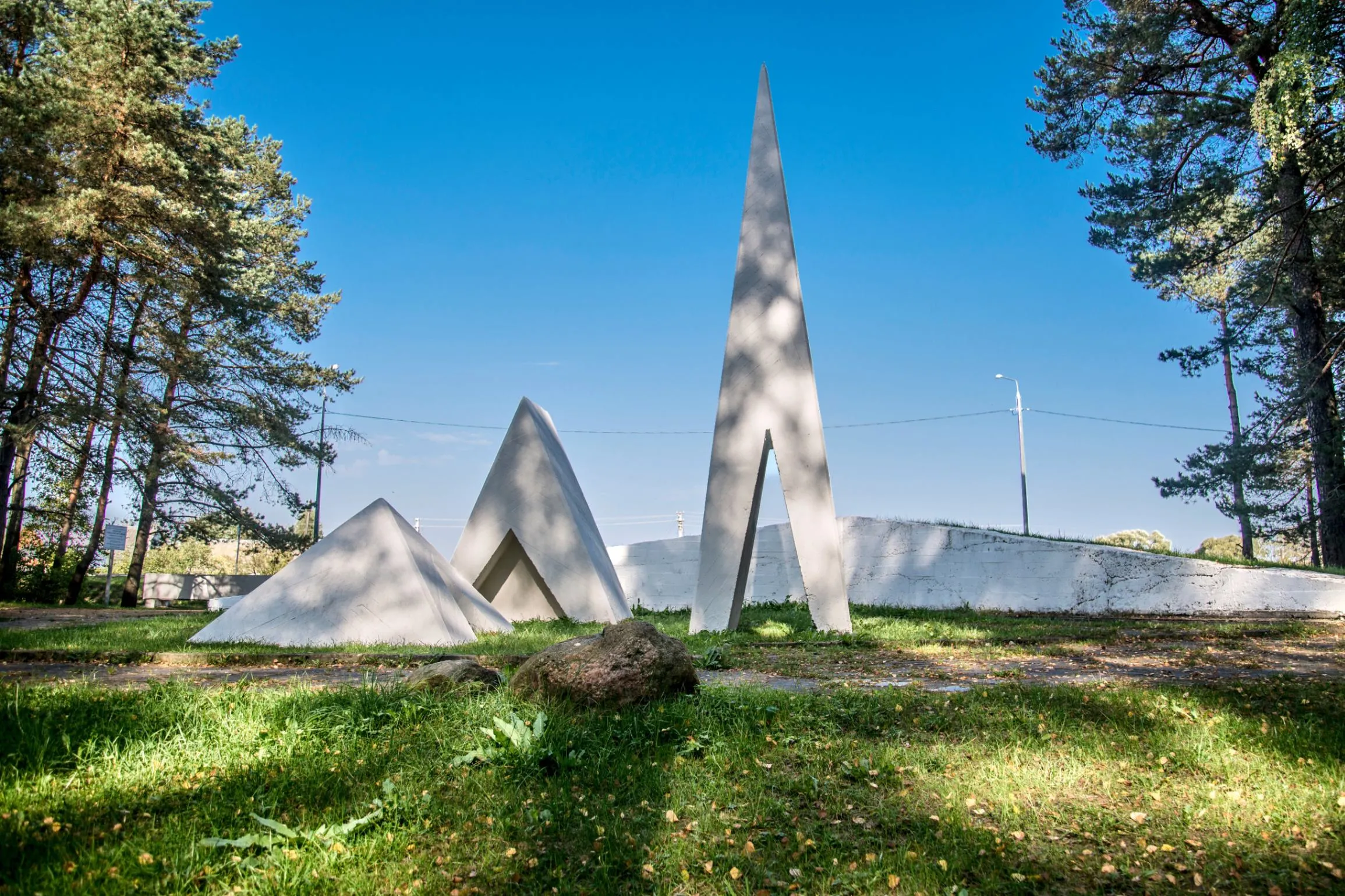
Katyn (20 kilometres from Smolensk) is a memorial complex where Polish officers shot by the NKVD in the spring of 1940 are buried, along with other victims of 20th-century repression. The memorial is designed with extreme restraint: paths through a forest, plaques bearing names, a austere composition, and a minimum of decorative elements.
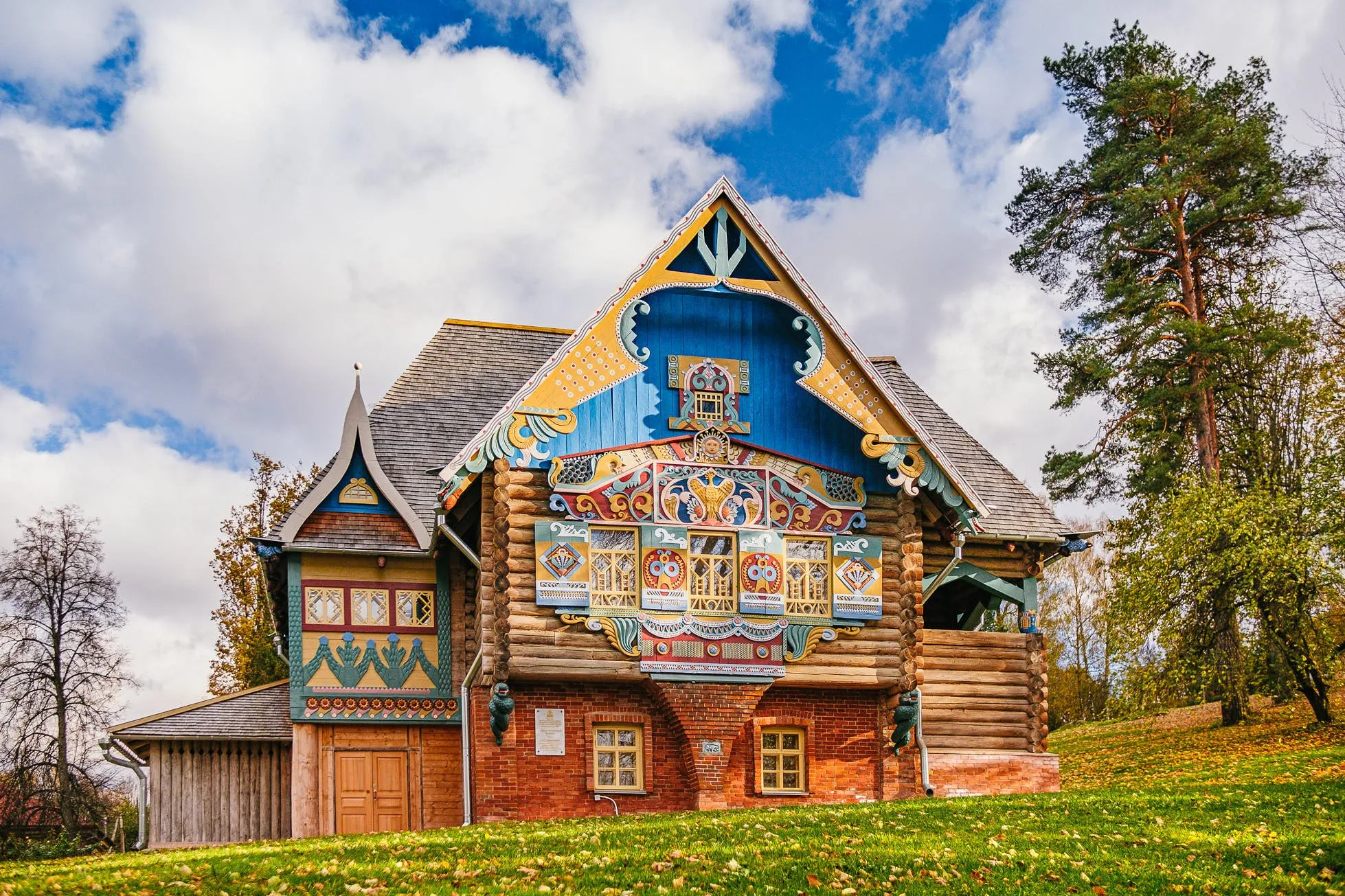
Flenovo (20 kilometres from Smolensk) is associated with Maria Tenisheva and the artistic life of the 19th and 20th centuries. The main attraction here is the historic architectural complex Teremok. It was built to a design by Sergei Malyutin in 1902 and looks like a fairy-tale wooden house adorned with carvings and vivid ornamentation. Nearby there is also a church painted by the artist Nicholas Roerich.
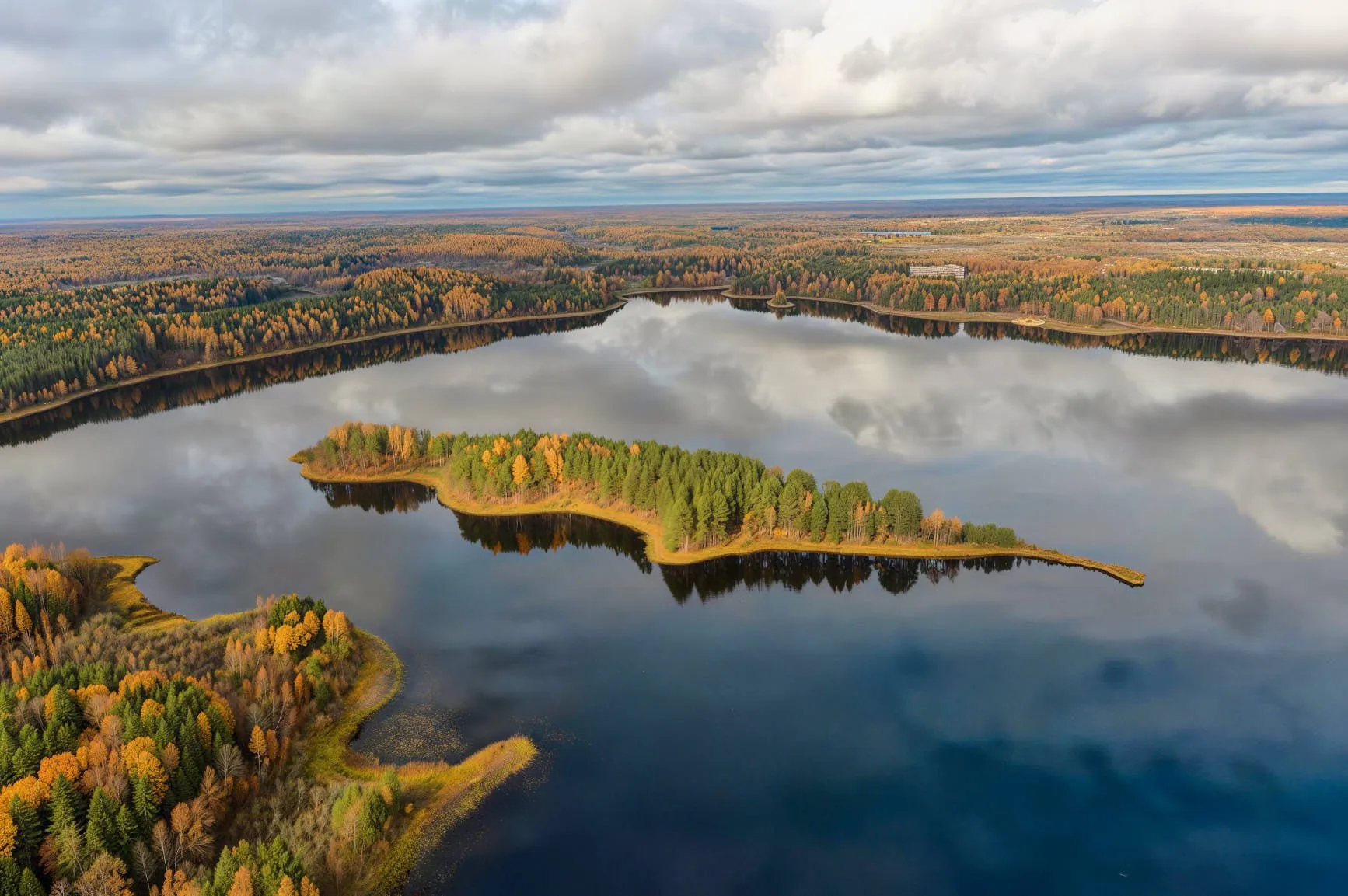
Smolenskoye Poozerye (120 kilometres from Smolensk) is a national park with 35 large and small glacial lakes. More than 250 historical and cultural monuments are located within its boundaries, and walking routes have been laid out for visitors.
Przhevalskoe is a settlement inside Poozerye and a convenient base from which to explore the national park. A house-museum of Nikolai Przhevalskyoperates here, and routes to the lakes and viewpoints begin nearby.
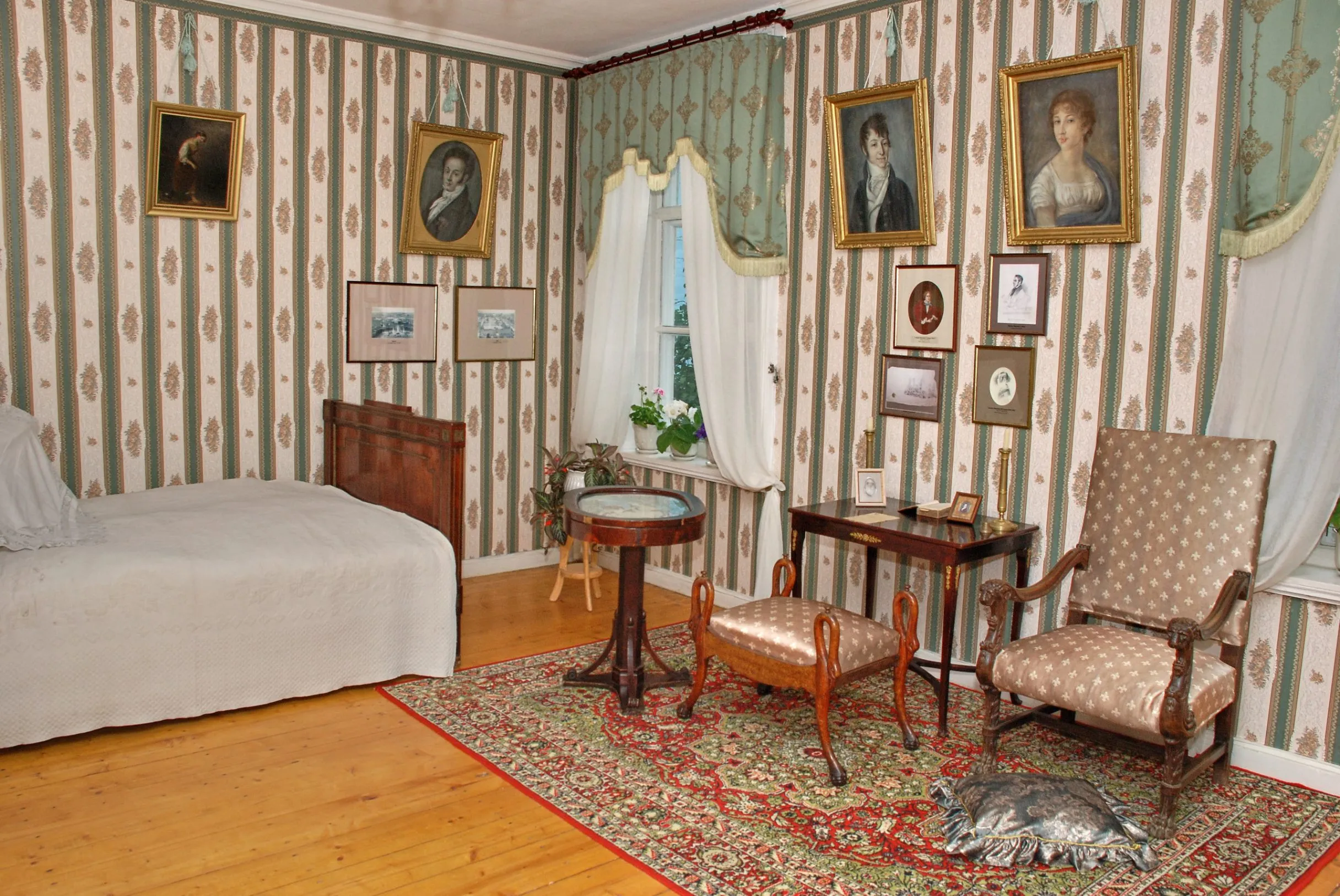
Novopasskoye (130 kilometres from Smolensk) is the estate of Mikhail Glinka and a memorial museum dedicated to the composer. Glinka spent 12 years of his childhood here and returned to the estate in his mature years. Today people come for the estate park, the ponds, the house-museum , and the setting in which the story of Russia's classical composer began.
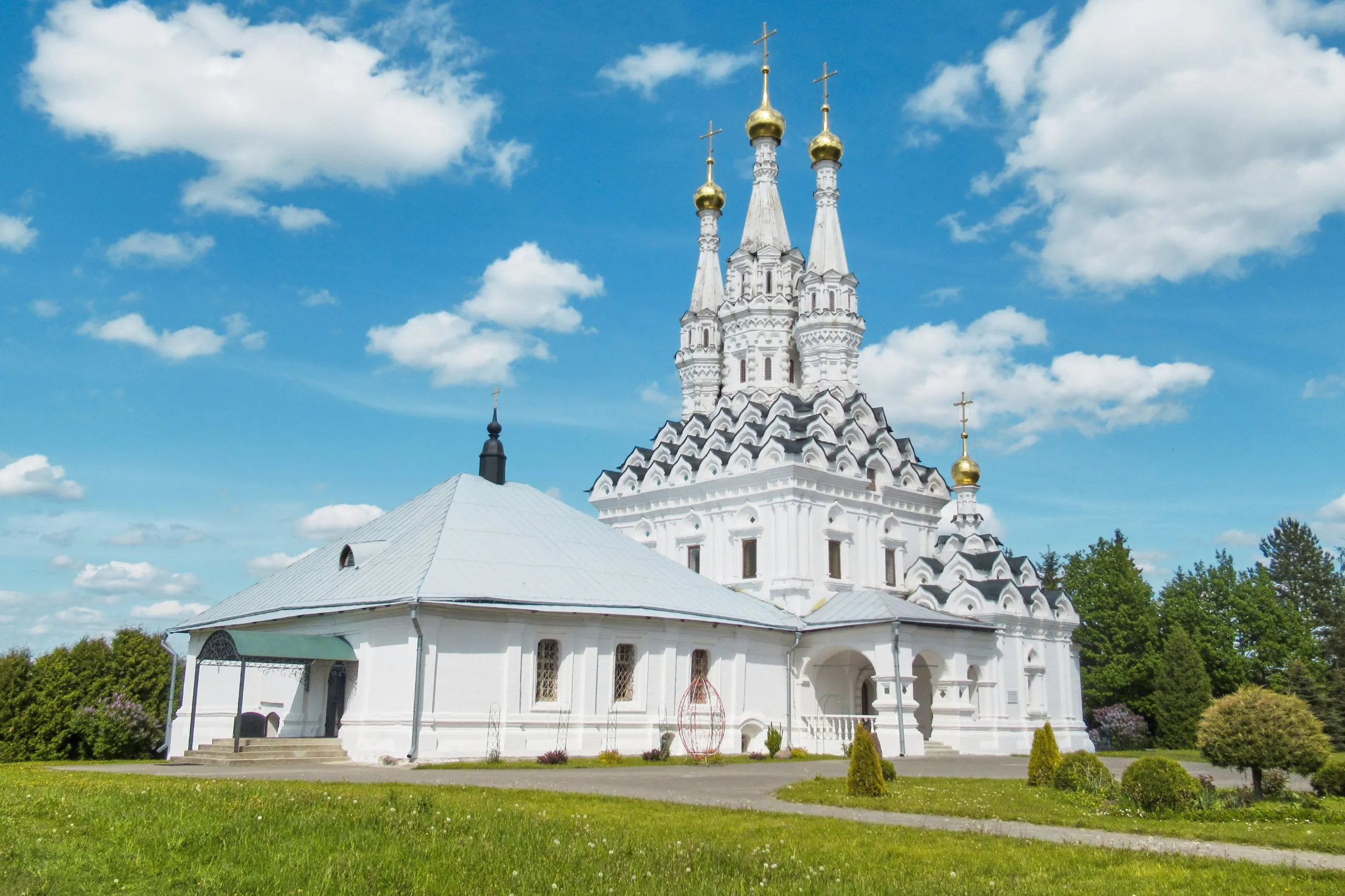
Vyazma (170 kilometres from Smolensk) is an ancient town in the Smolensk region worth visiting for its architecture. The Spassky Tower — the only surviving tower of the Vyazma fortress — has been preserved here. Vyazma is also home to the rare 17th-century Church of the Hodegetria, one of the few three-tent-roofed churches in Russia, which gives the townscape a subtly 'Byzantine' feel.
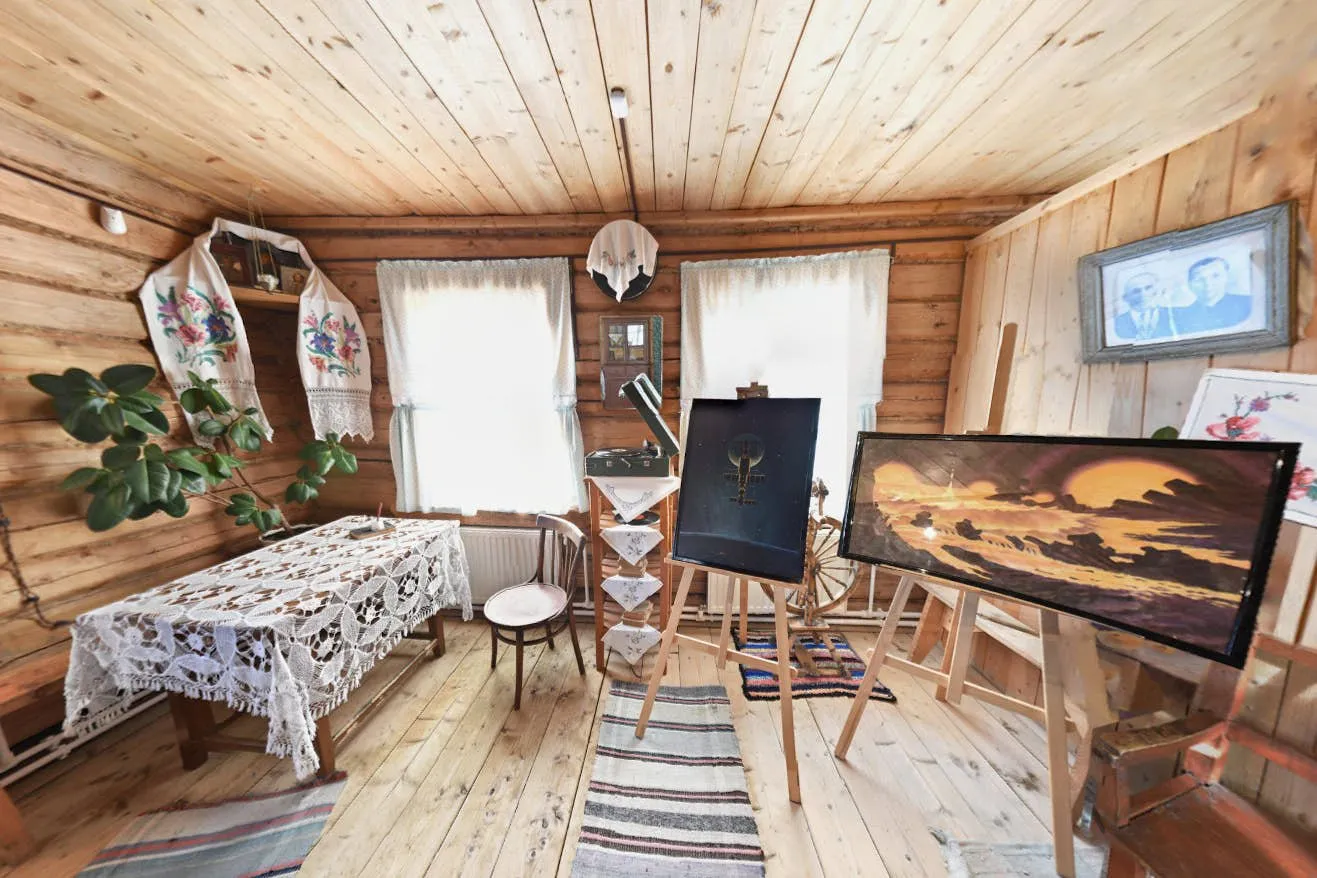
Klushino (250 kilometres from Smolensk) is the birthplace of Yuri Gagarin. The Gagarin family house-museum was built on the site of the original home and to the same dimensions, with the interior recreating the atmosphere of a peasant dwelling of the 1930s. Nearby, the dugout where the family lived during the occupation has been restored. This simple rural setting explains better than any exhibition just how modest and rural Gagarin's childhood was.
Food
Smolensk is not the kind of city people travel to for a dedicated food tour, but the center has plenty of good spots for breakfast and coffee, as well as restaurants for dinner.
Breakfast: Lanin, Marusya, Upitanny Yenot.
Coffee: Surf Coffee, Doktor Kofe, Aeblehaven.
Dinner: San-Jacques, Blon-Ogon, Kleshni i Khvosty.
Bars: Maneken, Kraftoman, «1865».

What to Bring Home
If you want to bring back something genuinely local, look toward sweets and handcrafted goods.
Smokva is a leaf-shaped fruit and berry pastila made without sugar, preservatives, or flavorings. In taste it resembles dried marmalade, and in appearance it looks like a thin flatbread rolled into a tube.
Konfekty are a dense fruit and berry dessert. They are often compared to dry jam and candied fruit. This kind of confection was being produced in Smolensk even before the revolution. The main brand is Smolenskiye Konfekty.

The Vyazemsky gingerbread is the main sweet souvenir of the Smolensk region. It is first mentioned in documents from 1646, and by the mid-19th century eight gingerbread factories were operating in the town. The gingerbread was so closely associated with Vyazma that it was stamped with the abbreviated name of the town — "VYAZ" — and in pre-revolutionary Russia the town itself was known for this treat.
Smolensk embroidery. Local patterns are called "ukrasy." They appear on shirts, towels, headscarves, shawls, and belts. The ornaments can be geometric or floral, featuring birds and animals, and the Smolensk tradition is strongly characterized by white, blue, and red colors. Common gift purchases are items where the pattern is clearly visible: napkins, table runners, towels, belts, or textile accessories.
Linen. You can take home a tablecloth, towel, napkins, or clothing.
Wooden toys from the Mikheyev workshop.
Look for all of these either at museum souvenir shops connected with Tenisheva and "Russkaya Starina," or at weekend markets where goods from the districts of the region are sold.

Where to Stay
The most convenient base is the historic center — near Lenina, Bolshaya Sovetskaya, and Oktyabrskoy Revolyutsii streets. All the main sights will be within walking distance.
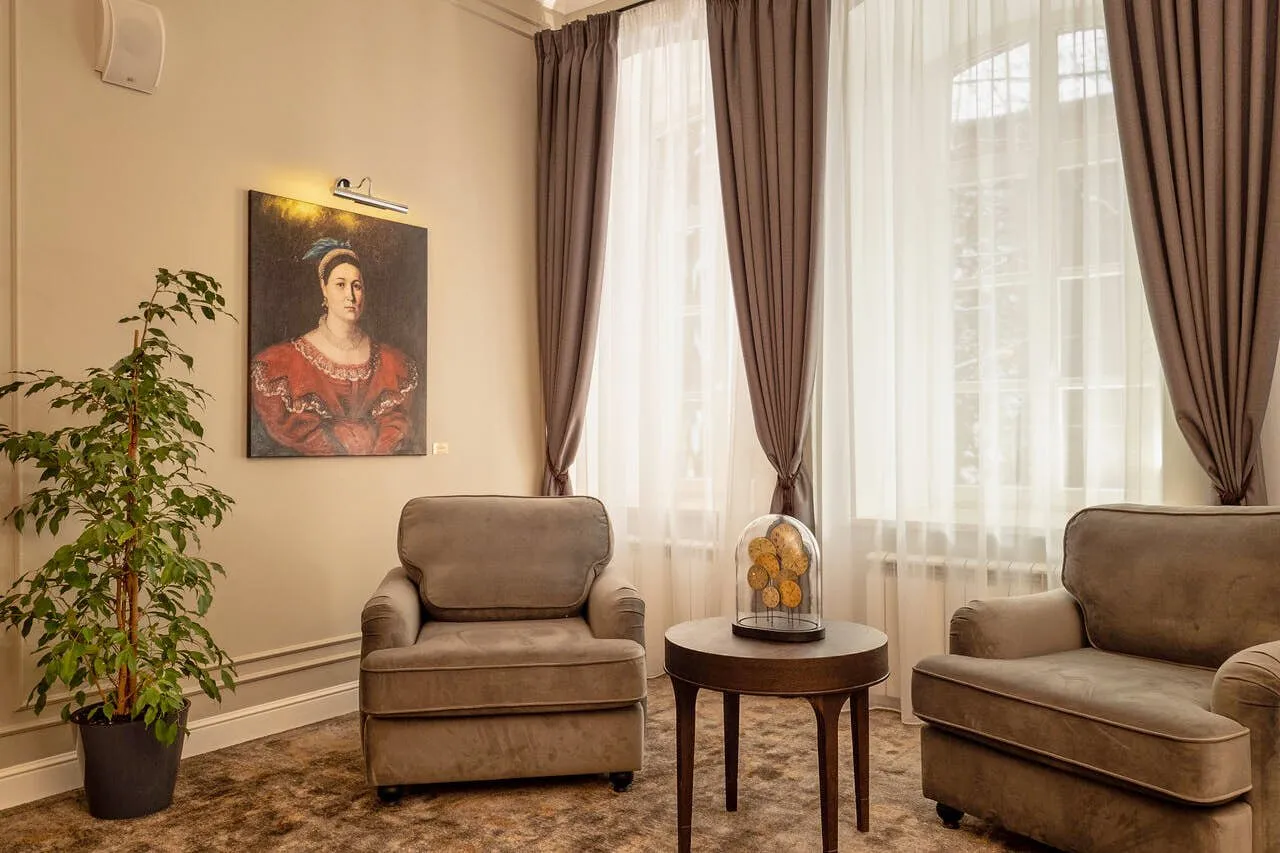
"Kommunisticheskaya, 12" — a huge studio apartment (60 square meters) in an old building with high ceilings. Stylish interiors: wooden floors, a rug, paintings on the walls. The neighboring door in the entrance leads to a coffee shop, and all the sights are close by. From 4,100 rubles (48.4 USD) per night.
"Pestrikov" — a great hotel in a pre-revolutionary red-brick building set against a backdrop of historic churches. Nothing historical survives inside, but the rooms are bright and cozy. From 10,500 rubles (123.9 USD) per night.
"Smolensotel" — simple rooms in what was once a Soviet-era hotel, starting from 5,200 rubles (61.3 USD). The location, however, is extremely convenient.
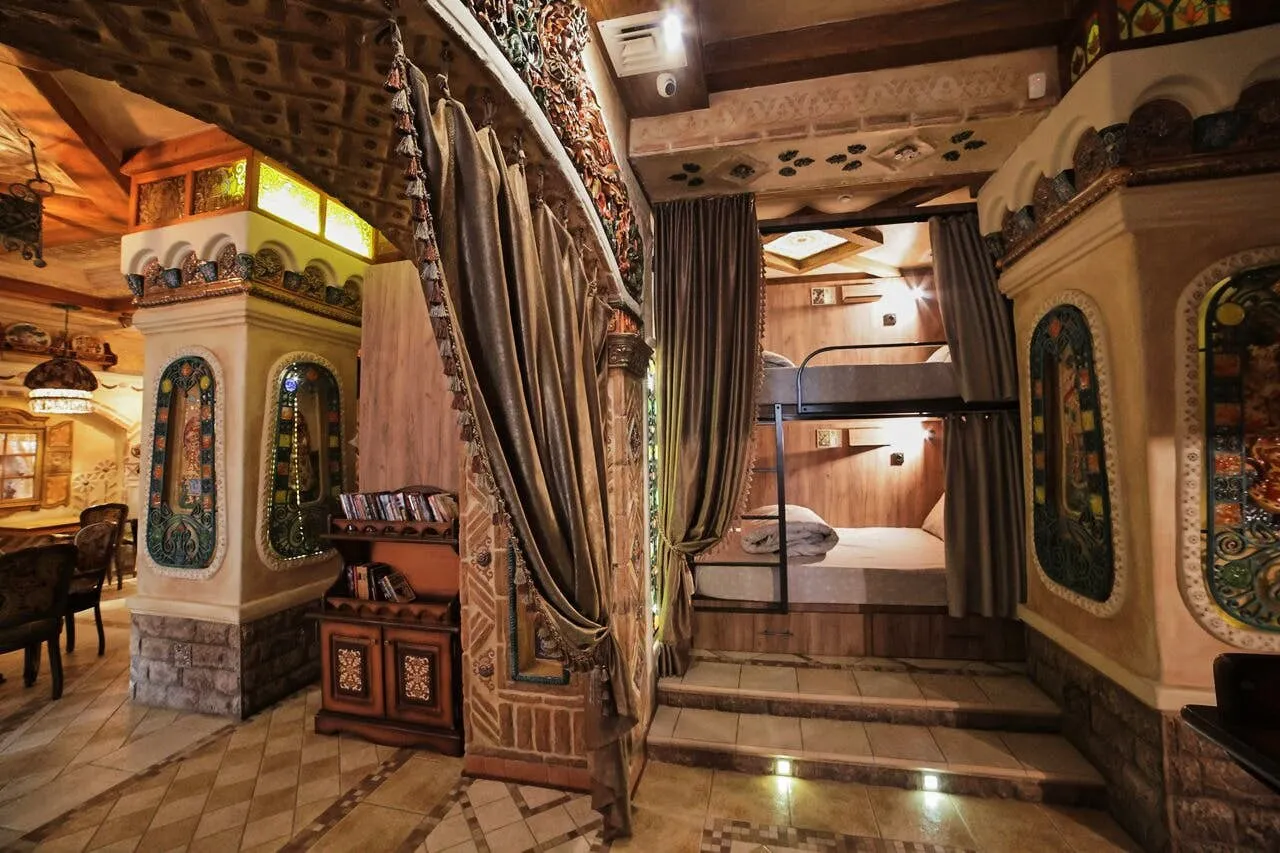
Divo — a hostel in a historic building with interiors that walk the line between authenticity and kitsch in the style of old Russian manor halls. In this case, though, that's more of a plus and a defining quirk of the place. Everything else is standard — shared kitchen and bathrooms. From 2,200 rubles (26 USD) per night per bed.
Getting Around the City
For a first trip around Smolensk, it helps to keep three options in mind: walking through the center, public transport for longer journeys, and taxis if you'd rather not figure out the routes. The historic center is more compact than it might seem, and many of the sights can comfortably be covered in a single walk.
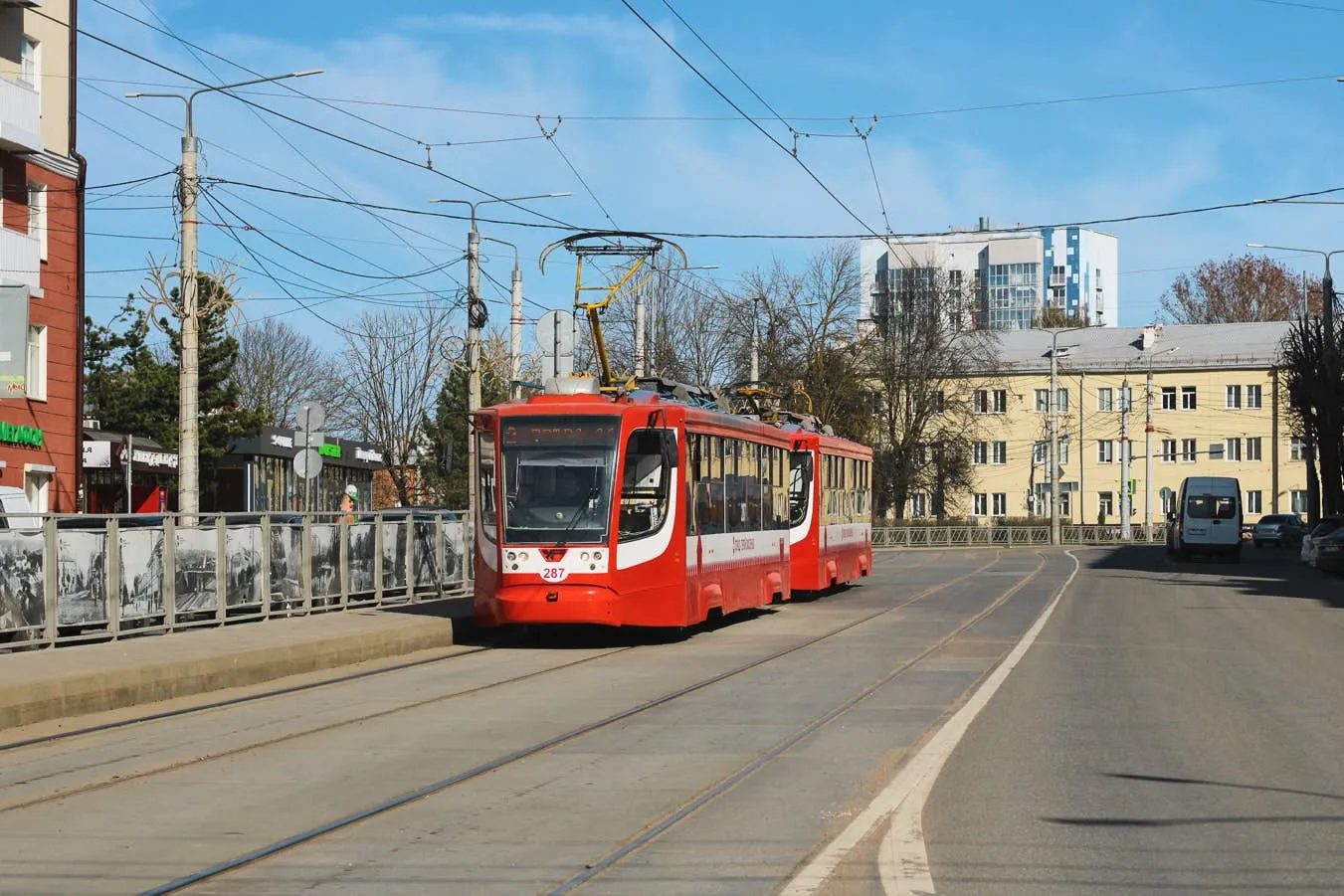
Public transport in Smolensk includes trams, trolleybuses, and buses. Timetables are published by the city transport authority on the website muttp.ru. Minibuses also run around the city; the easiest way to find them is through online maps and route directories such as T-Karta67 or the transport layer in Yandex Maps. A fare costs 37 rubles (0.44 USD) when paying by card and 39 rubles (0.46 USD) in cash. Minibuses accept cash only, and the fare is 42 rubles (0.5 USD).
A taxi is the simplest option if you don't want to work out the routes, are traveling with luggage, heading back late in the evening, or are staying outside the very center. The most convenient app to use for getting around the city is Yandex Go. A ride within the center will cost around 130–250 rubles (1.53-2.95 USD).
Getting There
The airport in Smolensk is not operating — it is undergoing reconstruction and may reopen in 2027. For now, the city is accessible only by train and bus.
Lastochka trains run from Moscow, with journey times ranging from 3 hours 40 minutes to 4.5 hours. Tickets cost 1,800–2,300 rubles (21.2-27.1 USD). Trains heading toward Belarus from Moscow also pass through Smolensk. There is also an Adler–Kaliningrad train, which can be used to travel from Voronezh, Rostov-on-Don, Krasnodar, and Sochi.
Buses from Moscow take around five to six hours. Tickets cost 1,500 rubles (17.7 USD). Buses also run from several other cities: Pskov, Bryansk, Belgorod, Kursk, Saint Petersburg, Voronezh, and Tula. There are also services from neighboring Belarus: Vitebsk and Mogilev. The most convenient place to check schedules is the Smolensk bus station website smolavtovokzal.ru, where you can also buy tickets.
By car, Smolensk is reached via the M-1 Belarus highway. This option is convenient if you want to include the surrounding area in your trip — Gnezdovo, Katyn, Talashkino, Klushino, or Vyazma. Be prepared for traffic congestion at the city entrance and in the center during peak hours, so it is best not to plan a tight schedule.
When to Go
The best time to visit is May through June. By then Smolensk is already green, but the stifling summer heat has not yet arrived. July and August are hot, though the city and surrounding region host a variety of festivals during those months. September is an excellent option if a city-focused itinerary matters more to you than nature. On 25 September Smolensk celebrates City Day, and the Golden Phoenix film festival — held here every year — also takes place at that time.
In winter, Smolensk is best suited to a short, relaxed weekend getaway: a stroll through the city centre, ice skating on Lenin Square, a visit to the museums, and a chance to soak up the festive pre-New Year market atmosphere.



_%D0%B8_%D0%A2%D1%80%D0%BE%D0%B8%D1%86%D0%BA%D0%B8%D0%B9_%D0%A1%D0%BE%D0%B1%D0%BE%D1%80.jpg)


.jpg)

_IMG_1920_2175.jpg)


_3.jpg)
